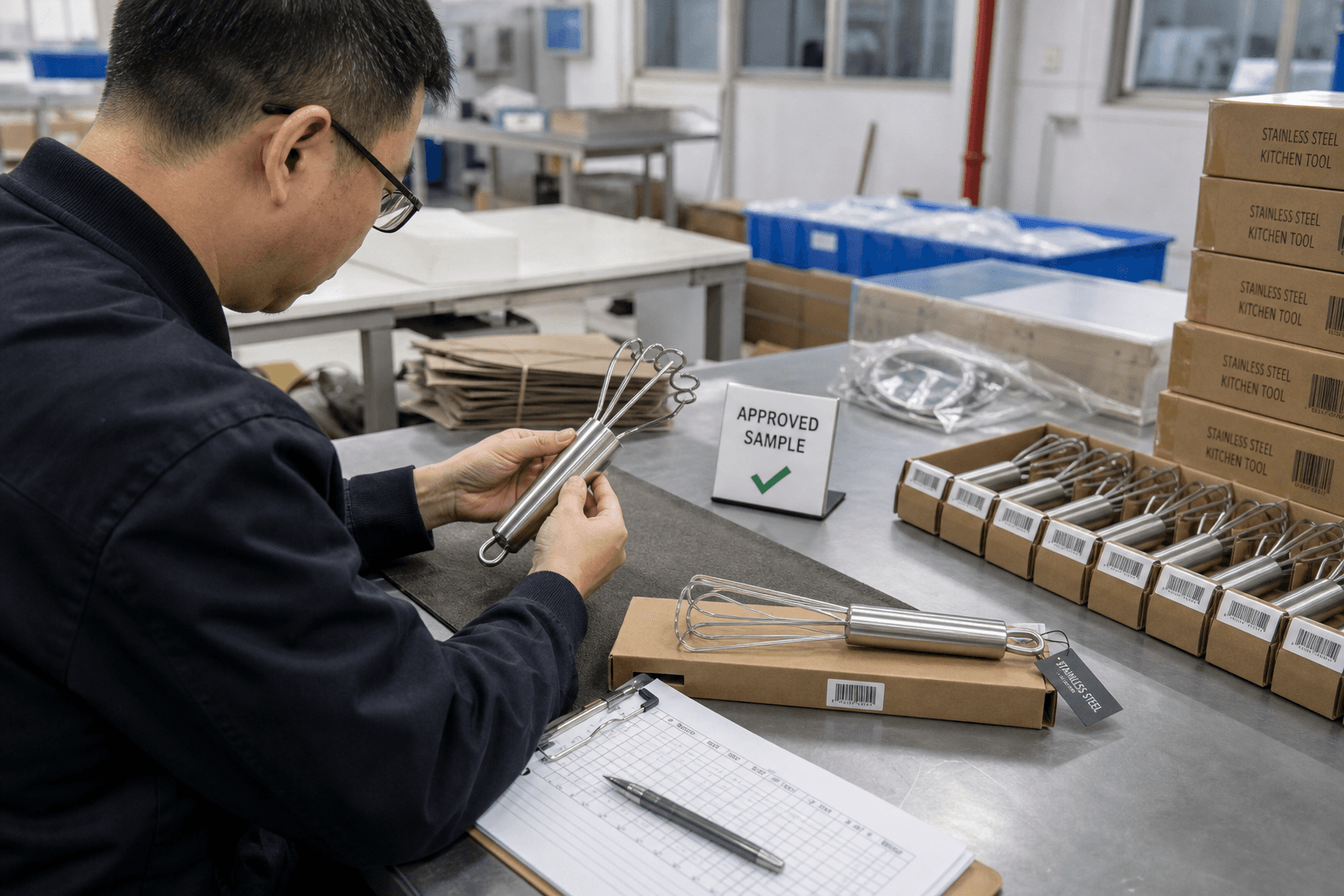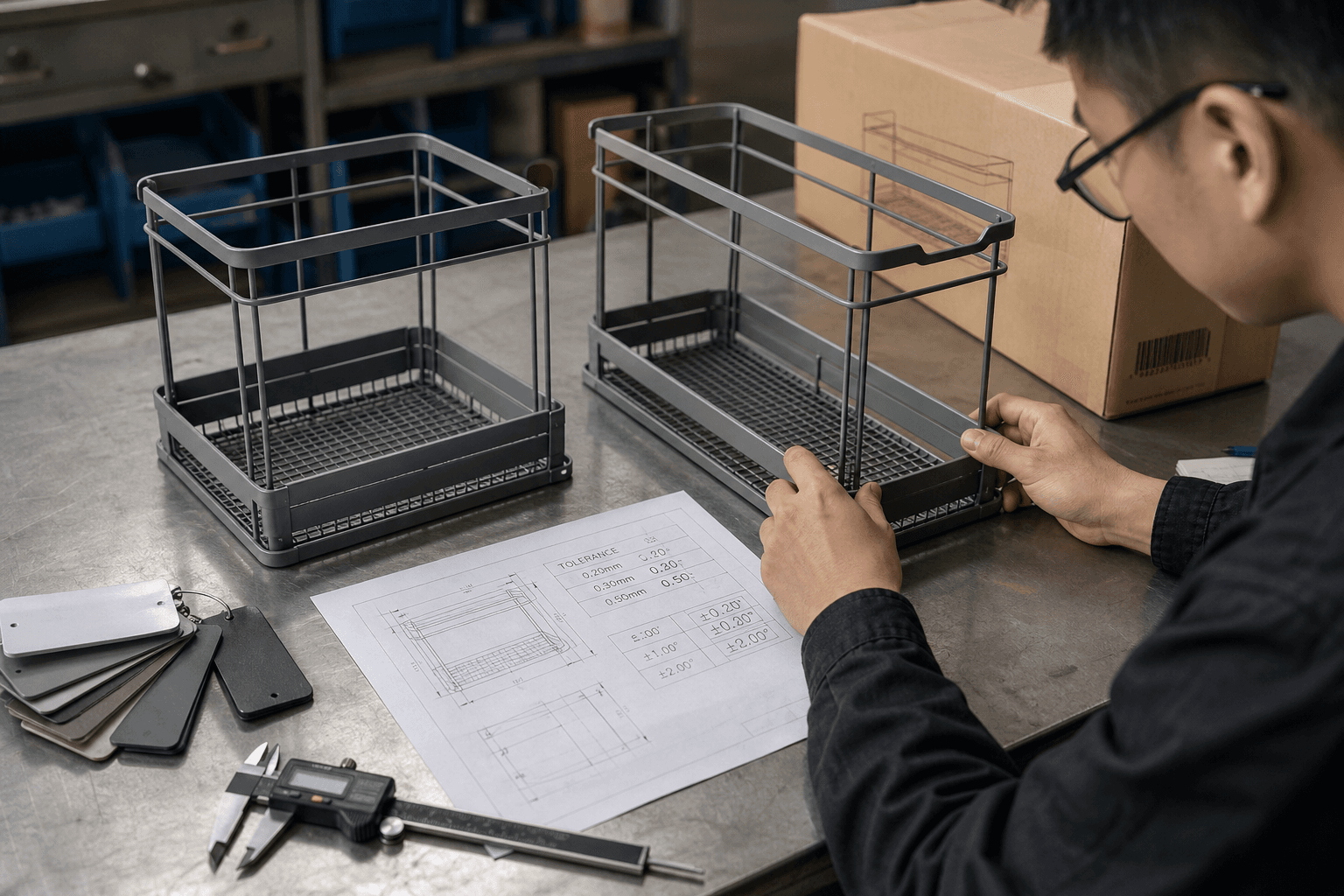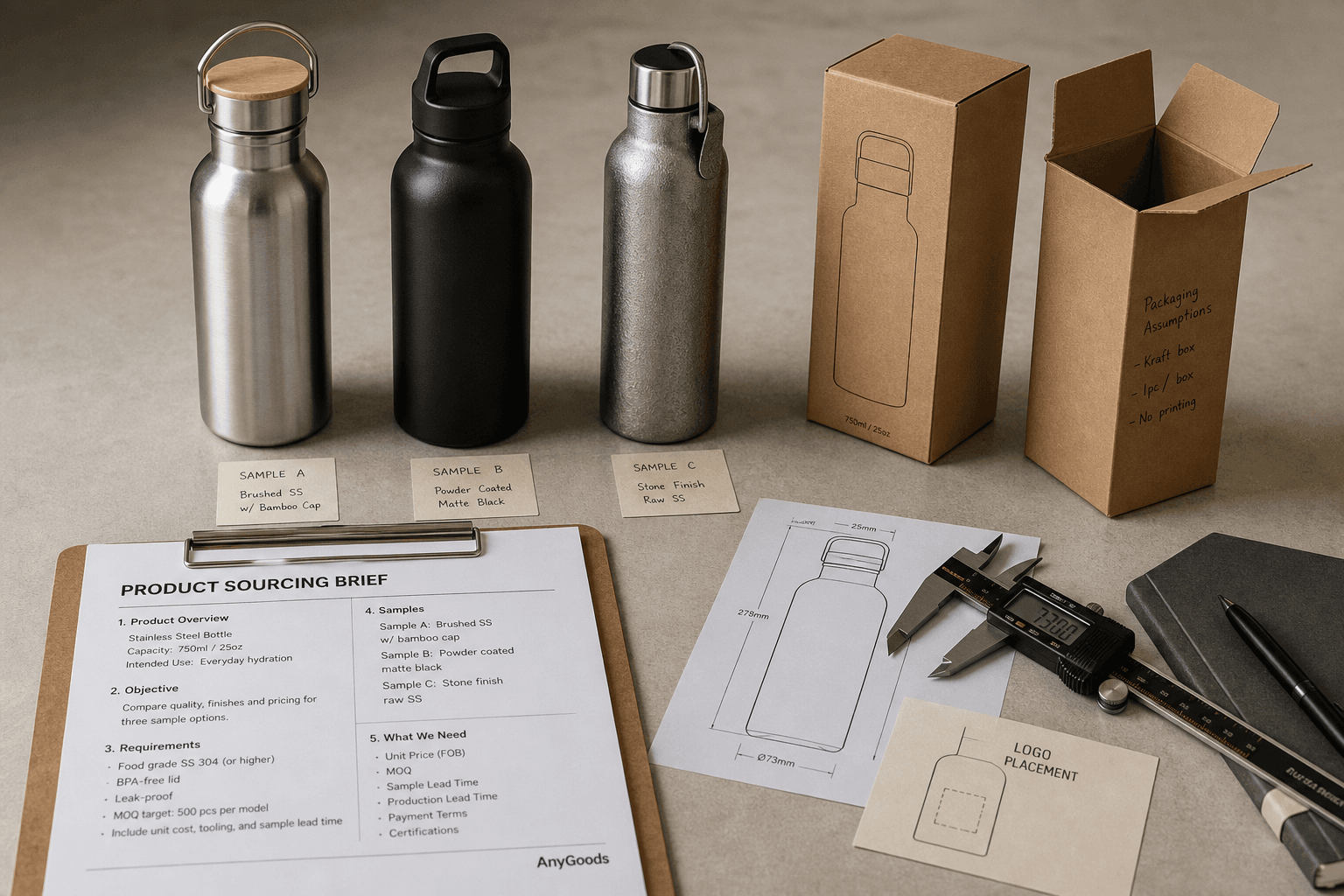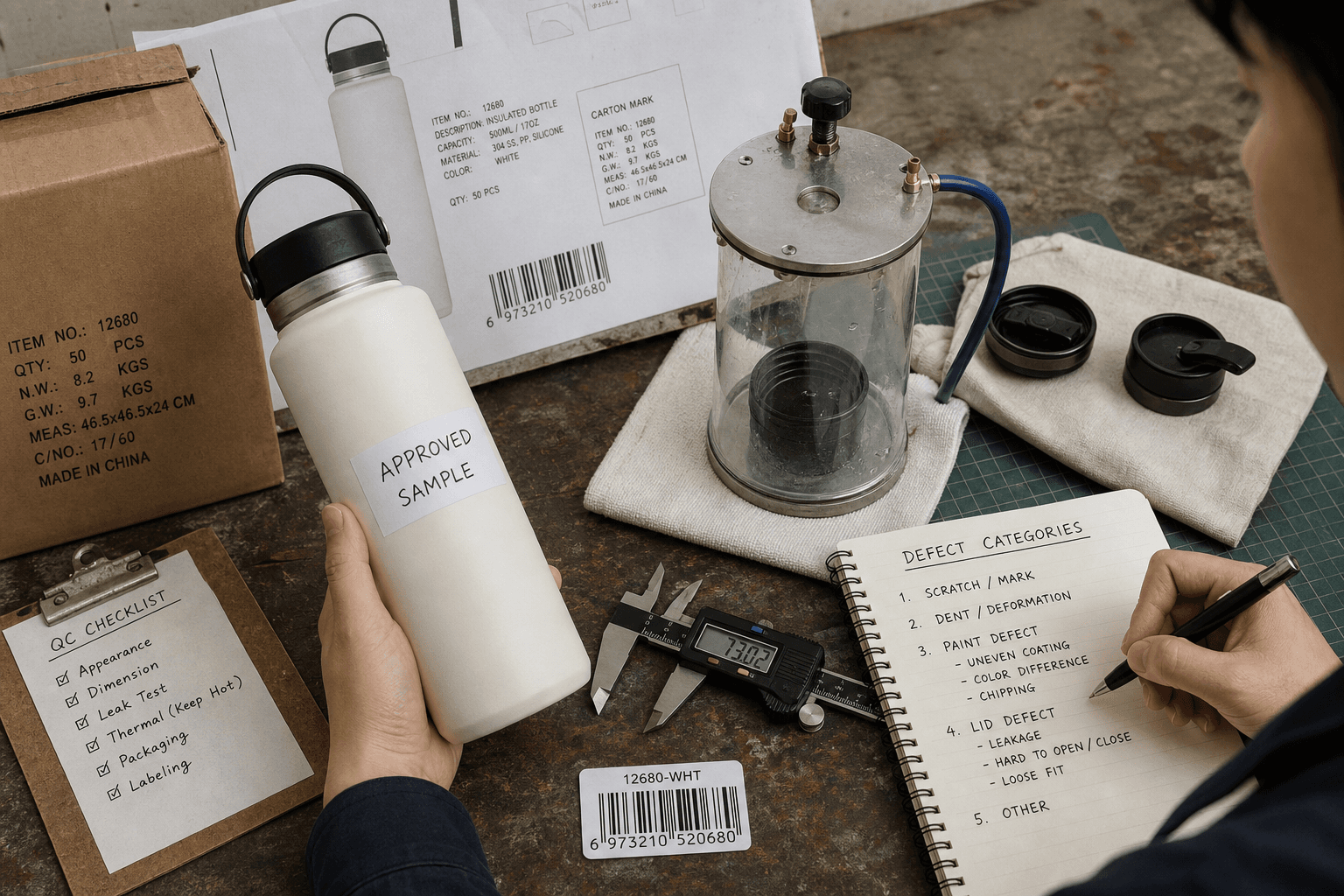
When the cartons are sealed is a bad time to discover you never defined “acceptable”
Here’s the familiar first-order mistake: the sample looked right, the quote was close enough, and everyone agreed to “inspect before shipment.” That sounds responsible until the lot is finished and the arguments start. Is the logo drift acceptable? Does one leaking lid mean rework, replacement, or a full hold? Is the missing insert annoying or shipment-blocking? Who decides?
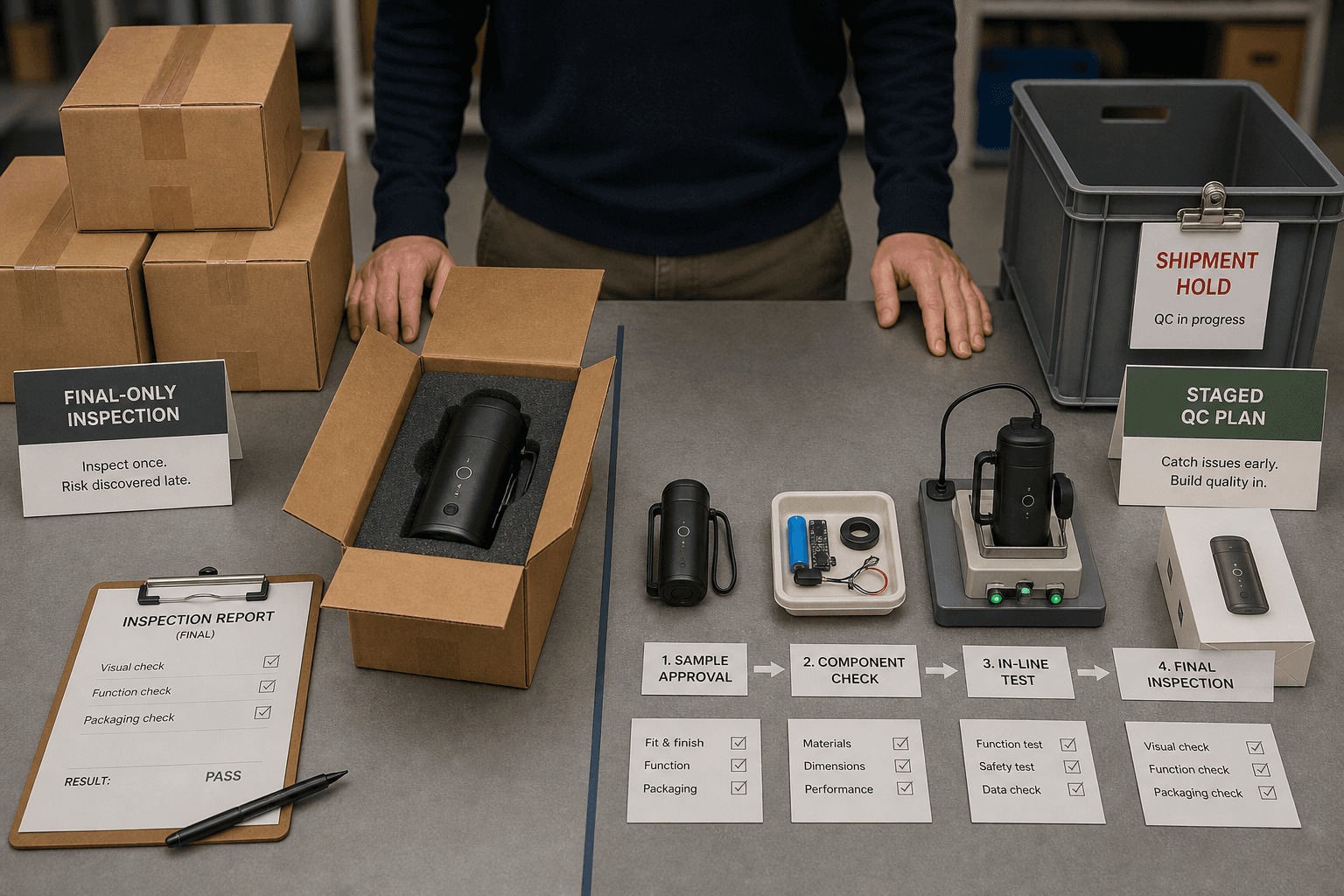
That is what a first production run quality control plan is supposed to settle before bulk production starts. My recommendation is straightforward: write the release system before the factory begins mass production. Use the approved sample, purchase order, artwork, labels, and product claims to define what will be checked, when it will be checked, what counts as a defect, and what result holds shipment.
The tradeoff that changes the recommendation is simple. If a problem is cheap to sort at the end, you can keep the plan leaner. If the product is regulated, safety-sensitive, or painful to rework after packing, move more checks upstream into pre-production review, incoming materials, and in-line inspection.
The approved sample is not the standard by itself
An approved sample proves intent. It does not tell the inspector how far a print can drift, what scratch depth matters, how to test a closure, or whether the barcode, insert, and carton mark all need to match the PO version.
For a first run, the sample needs to be converted into written inspection points. In practice, that usually means four things.
- A product specification: dimensions, materials, finish, color reference, assembly points, packaging format.
- Defect definitions: critical, major, and minor defects with examples tied to the actual product.
- Inspection stages: what is checked before production, during production, before packing is complete, and before shipment.
- A release rule: who can approve rework, who can waive a minor issue, and what cannot be waived.
If those inputs are still fuzzy, fix that before you worry about inspection bookings. The earlier document discipline is the same one described in A product sourcing brief that gets comparable supplier replies.
Read the video transcript
If you're counting on a final inspection to protect your first production run, trouble often starts after cartons are sealed, when nobody agreed what acceptable actually means. The article’s advice is to define checks, defect levels, timing, and shipment holds before mass production, because an approved sample shows intent but not inspection standards. A final-only AQL approach helps decide whether to release a sampled lot, but it can't prove the process was stable or replace product-specific requirements. In the bottle example, leaking lids, print rub-off, wrong barcodes, and carton errors cost more after packing, so the plan moves those checks upstream. A sensible next move is asking the supplier exactly when print adhesion, lid parts, labels, and carton marks are verified, so inspection follows rework cost. This won't remove every risk, especially where compliance or labeling also matters, but clear hold points and records give you calmer, faster shipment decisions.
AQL is a release tool, not the quality plan
If you remember one point from this article, make it this one: AQL tables do not define your product quality. They help you decide whether to release a lot from a limited sample.
That is not opinion. ISO’s own explanation of the ISO 2859 family describes acceptance sampling as a bilateral release method and notes that formal inspection still carries the risk of an incorrect conclusion (ISO 2859-4 online text). NIST says the same thing more plainly: acceptance sampling means taking a sample from a lot and deciding the lot’s disposition from that sample (NIST acceptance sampling overview). ISO’s introduction to the series also confirms that these are recognized sampling procedures, not a universal product-quality template (ISO 28590 overview).
That finding matters because many first-time buyers treat “book a final inspection” as if it settles quality by itself. It doesn’t. A final inspection helps you make a shipment decision from a sample. It does not prove the factory process was stable. It does not replace product-specific compliance work. And it cannot rescue a buyer who never wrote down what the inspector was supposed to look for.
So don’t start with “what AQL should I use?” Start with “what must be true before I’m willing to release this lot?”
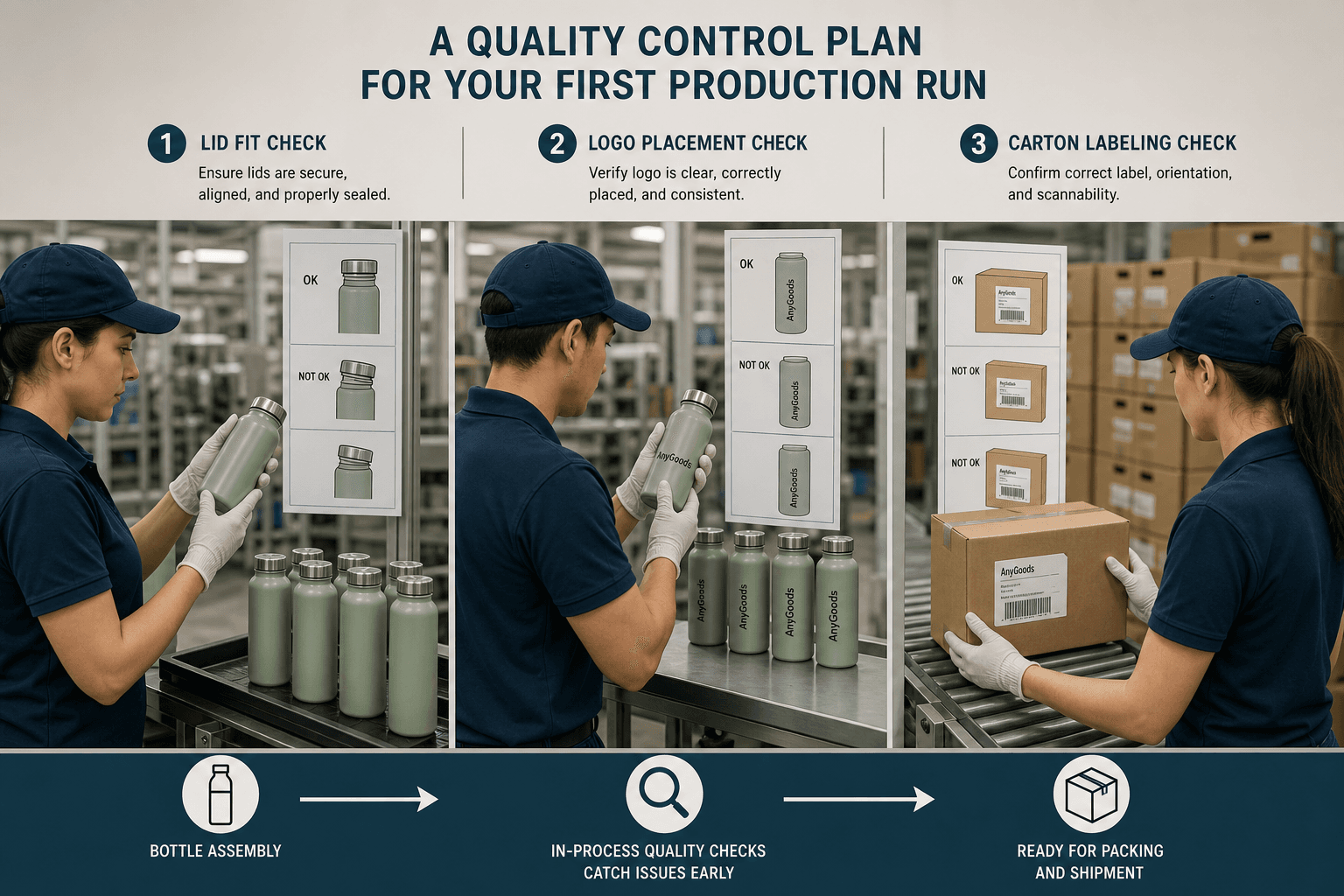
Put checks where failure is cheapest to catch
A good first-run plan follows rework cost, not ceremony.
If a defect becomes expensive once units are packed into retail boxes and master cartons, move the check earlier. If the issue is mostly cosmetic and easy to sort at the end, a later check may be enough. That sounds almost too obvious to print, but it is the decision that keeps a QC plan from becoming dead paperwork.
For example, imagine you sell a private-label insulated bottle and you’re placing a first order for 3,000 units. This is hypothetical, purely illustrative.
The approved sample has a matte finish, printed logo, screw lid, insert card, unit barcode label, and master cartons packed 24 units each. Your risk is not one big thing called “quality.” It’s five different failure modes with different costs:
- leaking lids
- logo print rubbing off
- visible dents on the bottle body
- wrong barcode or missing insert
- wrong carton counts or carton markings
A usable supplier instruction would say something like this:
“Before mass production, confirm the bulk lid gasket, print method, logo position tolerance, barcode artwork, insert file, and carton markings against the approved sample set and PO version. During production, check lid assembly consistency and print adhesion in line. Before all master cartons are sealed, verify unit barcode labels, insert placement, carton assortment, and carton marks. Pre-shipment inspection must include the agreed leak test, workmanship check, count verification, and packaging accuracy. Shipment is on hold if functional failures exceed the agreed release rule or if packaging information does not match PO documents.”
That note does three useful things. It names the checks. It places them at the right stage. And it tells the supplier what findings change the shipment decision.
Worked example: define defects before you argue about them
Staying with the bottle example, the first decision is what counts as a defect.
You do not need legal prose here. Plain language is better, provided it is specific. For example:
- Critical: bottle leaks under the agreed test method; wrong material or missing safety-related component where applicable.
- Major: logo visibly outside the approved position tolerance; lid thread issue that prevents normal closing; deep dent on a visible surface; wrong barcode; wrong or missing insert.
- Minor: small finish mark on a non-prominent area that does not affect normal use or shelf appearance at the agreed viewing distance.
Now give the supplier questions that force useful answers instead of vague reassurance.
Ask:
- “What exact print process will be used in bulk, and is it the same process used on the approved sample?”
- “At what production stage can you test print adhesion before all units are packed?”
- “How will you confirm the lid gasket and closure parts match the approved sample and BOM version?”
- “Who verifies that unit barcode labels, carton marks, and the packing list all match the PO version?”
What do those answers change? Quite a lot. If the supplier says print adhesion can only be checked after the full lot is packed, your risk is higher. If barcode control is handled manually with no version check, packaging error risk is higher. If gasket control depends on verbal confirmation rather than part records or approved samples, functional risk is higher. None of that automatically kills the order, but it should change how early you inspect and how much ambiguity you tolerate.
Worked example: decide whether one extra inspection step earns its keep
The second decision from the same bottle order is whether to add one more in-line check.
Use a simple cash frame. Hypothetical numbers only.
- Order quantity: 3,000 units
- Factory price: $6.20 each
- Goods value: 3,000 × $6.20 = $18,600
- Estimated landed add-ons before delivery to your warehouse: assume $5,400 total for freight, duties, fees, and local delivery
- Cash committed before sell-through: $18,600 + $5,400 = $24,000
Now suppose an extra in-line inspection visit would cost an assumed $300 to $500. That number is not a benchmark; it is just an example to show the decision logic.
If that visit can catch a bulk print-method change, lid assembly drift, or packaging mismatch before all 3,000 units are packed, the spend may be justified because it protects a much larger cash position. If the product is simple, packaging is plain, and rework is easy, you may skip the extra check and rely on a tighter pre-shipment release decision instead.
That is why QC belongs in the same conversation as landed cost and cash exposure, not in a separate “operations” bucket. If you need to compare that spend against the rest of the order economics, How to compare manufacturing quotes beyond the unit price and Landed cost calculation ecommerce: build the model before you approve the order are the right supporting reads.
Some products need document checks as much as product checks
This is where first-run plans often go soft. Buyers focus on workmanship and forget that labels, claims, and classification can change the release decision just as much as a scratch or loose part.
For example, imagine you are launching a textile accessory intended for children 12 and under. This scenario is hypothetical and not a legal determination. In the U.S., whether an item is treated as a children’s product depends on factors including design, packaging, representations, and marketing (CPSC children’s products guidance). Children’s products generally fall within the CPSIA framework for applicable rules, testing, and certification structure (CPSIA overview).
That changes the QC plan immediately. A final visual inspection is not enough by itself. Before production release or shipment release, the buyer needs to resolve at least three points: whether the product is being presented as a children’s product, what records or tests apply to the materials and components, and whether the packaging and marketing language is consistent with that classification.
If the item is also a textile or wool product, FTC guidance says most such products must carry labels stating fiber content, country of origin, and the identity of the manufacturer or another responsible business (FTC textile labeling guidance). So the QC plan should include label-content verification against the approved composition and origin records, not just seam inspection.
A useful supplier script for that conversation would be:
“Please confirm the exact fiber composition, country of origin statement, and responsible-party information that will appear on sewn-in and packaging labels. Send label artwork for approval before bulk printing. Confirm whether any material substitutions or trim changes from the approved sample affect those labels or the applicable testing path.”
There is a similar trap with origin claims. FTC guidance says an unqualified “Made in USA” claim requires the product to be “all or virtually all” made in the United States, and the marketer must have a reasonable basis for that claim; FTC also distinguishes this standard from ordinary country-of-origin marking requirements (FTC Made in USA guidance). QC can verify that the shipped product and packaging match the documented claim. QC does not create the legal basis for the claim. Important difference.
Your release rule needs hold points, not hopeful language
A first-run quality plan does not need to look like a corporate binder no one reads. It does need explicit hold points.
Start with three.
What stops production? Usually wrong materials, wrong components, wrong artwork version, or an early functional failure that suggests the approved sample was never actually replicated.
What stops packing? Usually barcode mismatches, insert errors, assortment mistakes, recurring assembly defects, or packaging drift that becomes much more expensive once cartons are sealed.
What stops shipment? Usually failed functional checks, a failed sampling result under the agreed release method, missing required documents, or unresolved labeling and claim discrepancies.
Write those hold points into the plan before goods are finished. Otherwise the shipment decision gets made in the least glamorous conditions possible: late at night, under deadline, with freight bookings looming and everyone pretending a known issue is “probably fine.”
Keep the compliance records with the QC plan
The importer of record is responsible for using reasonable care in entry, classification, and value matters, according to CBP’s trade guidance (CBP tariff classification guidance). Where classification is uncertain, CBP’s binding ruling program exists because details such as product description, composition, and samples can matter (CBP binding ruling program).
That means your first-run plan should preserve more than defect photos. Keep the bill of materials, composition details, intended use, packaging details, artwork versions, and exact product description tied to the PO and approved sample. Those records help with customs, product claims, and later dispute resolution.
One more point worth stating plainly: if a business obtains information suggesting a product defect or noncompliance that could create a substantial product hazard, it may have reporting duties to CPSC (CPSC duty to report guidance). That does not mean every failed inspection turns into a crisis. It does mean “the launch date is close” is not a quality standard.
The next supplier conversation should settle these three decisions
Before you approve mass production, resolve three points in writing.
First, which product characteristics are safety-critical, claim-critical, or expensive to rework after packing?
Second, which checks happen before materials are consumed, units are fully assembled, or cartons are sealed?
Third, who can approve rework, who can waive a minor issue, and who can hold shipment entirely?
If your team can answer those cleanly, you have the start of a real first-run quality control plan. If not, booking a pre-shipment inspection is mostly administrative theatre.
If you need help turning a sample, supplier quote, and product requirements into a production-ready QC and release process, AnyGoods can support that through its services or a direct inquiry.
Product sample review
Record how a sample performs against the brief and what must change before production.
A sample review is not a product certification. Verify the requirements and appropriate test methods for the product and destination.
See a completed example
- Sample identity
- Record supplier, sample date, version, material and drawing revision. Photograph identifying details.
- Dimensions and construction
- Measure specified dimensions and inspect seams, edges, fasteners or joints. Record actual observations and agreed tolerances.
- Function and intended use
- Describe a repeatable use test and the result. Example: place the desk organizer on a flat surface and check whether it sits securely.
- Materials and finish
- Compare the sample with agreed materials and color references. Record visible variation and evidence supplied for material claims.
- Packaging and shipment
- Inspect protection, fit, labels and carton information. Identify transit tests that should be agreed for the actual shipment.
- Required documentation
- List product-specific test reports or compliance information that need independent verification; do not infer compliance from appearance.
- Decision and next revision
- Approve, reject or request changes. Name the approver and create an unambiguous reference for the next sample or production run.
Make your own brief
Your entries stay in this tab. Download before leaving; they are not saved or sent to AnyGoods.
Sources & further reading
- ISO 2859-4:2020 online textiso.org
- ISO 28590:2017 introduction to the ISO 2859 seriesiso.org
- NIST acceptance sampling overviewitl.nist.gov
- CPSC children’s products guidancecpsc.gov
- CPSIA overviewcpsc.gov
- CPSC duty to report guidancecpsc.gov
- CBP tariff classification guidancecbp.gov
- CBP binding ruling programhelp.cbp.gov
- FTC Made in USA standardftc.gov
- FTC textile labeling guidanceftc.gov
Published by AnyGoods Editorial. Examples are illustrative unless a source is identified. Updated .