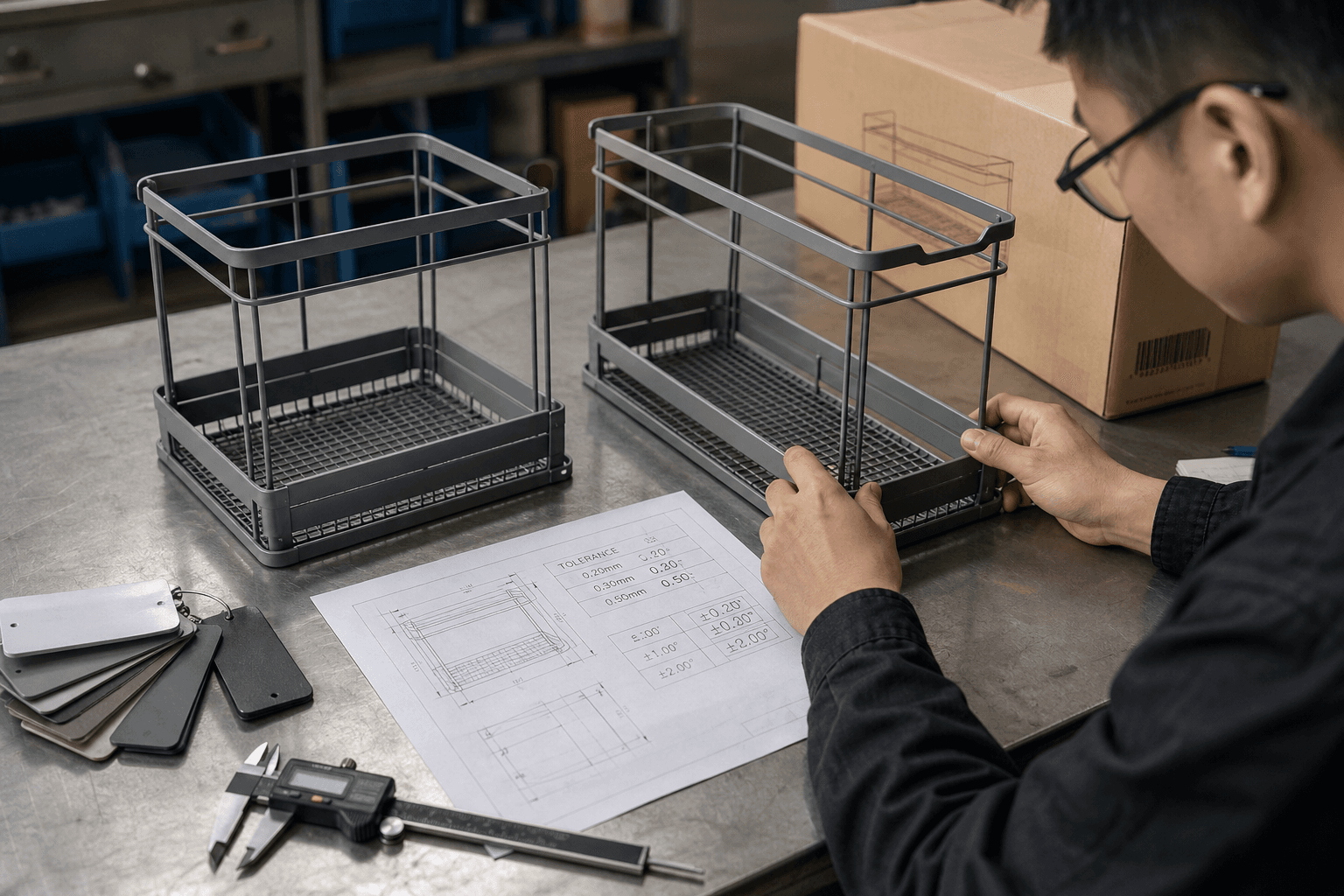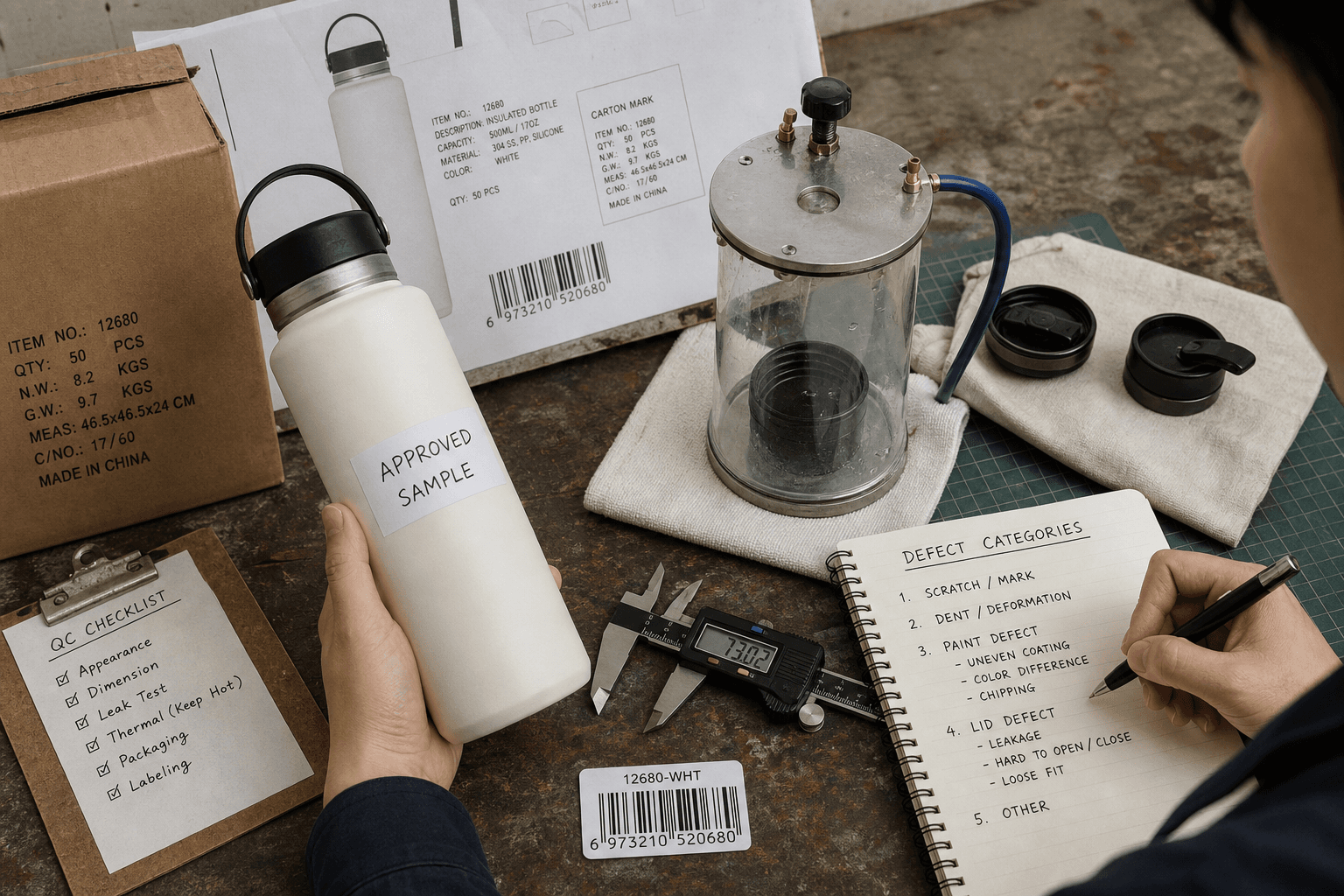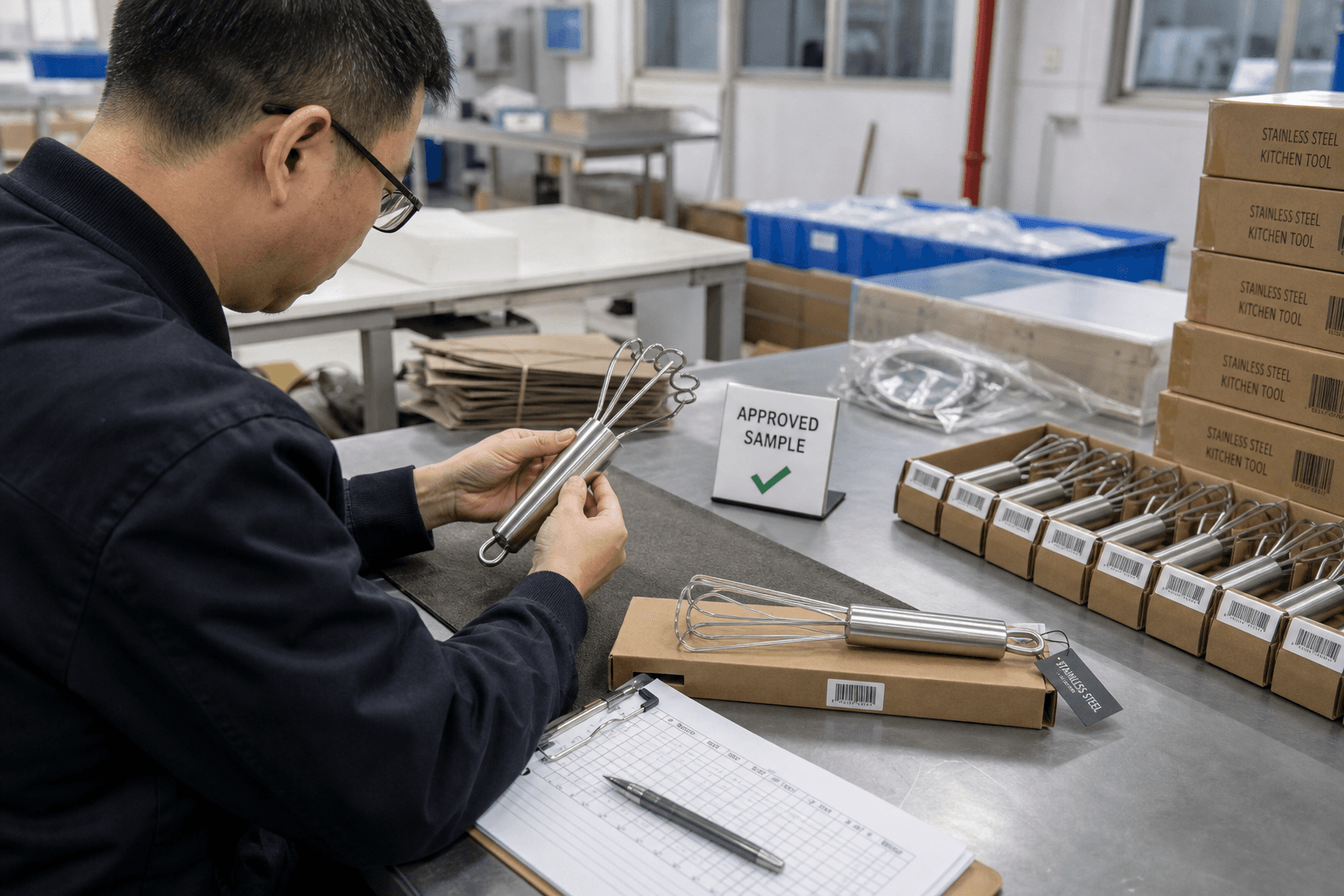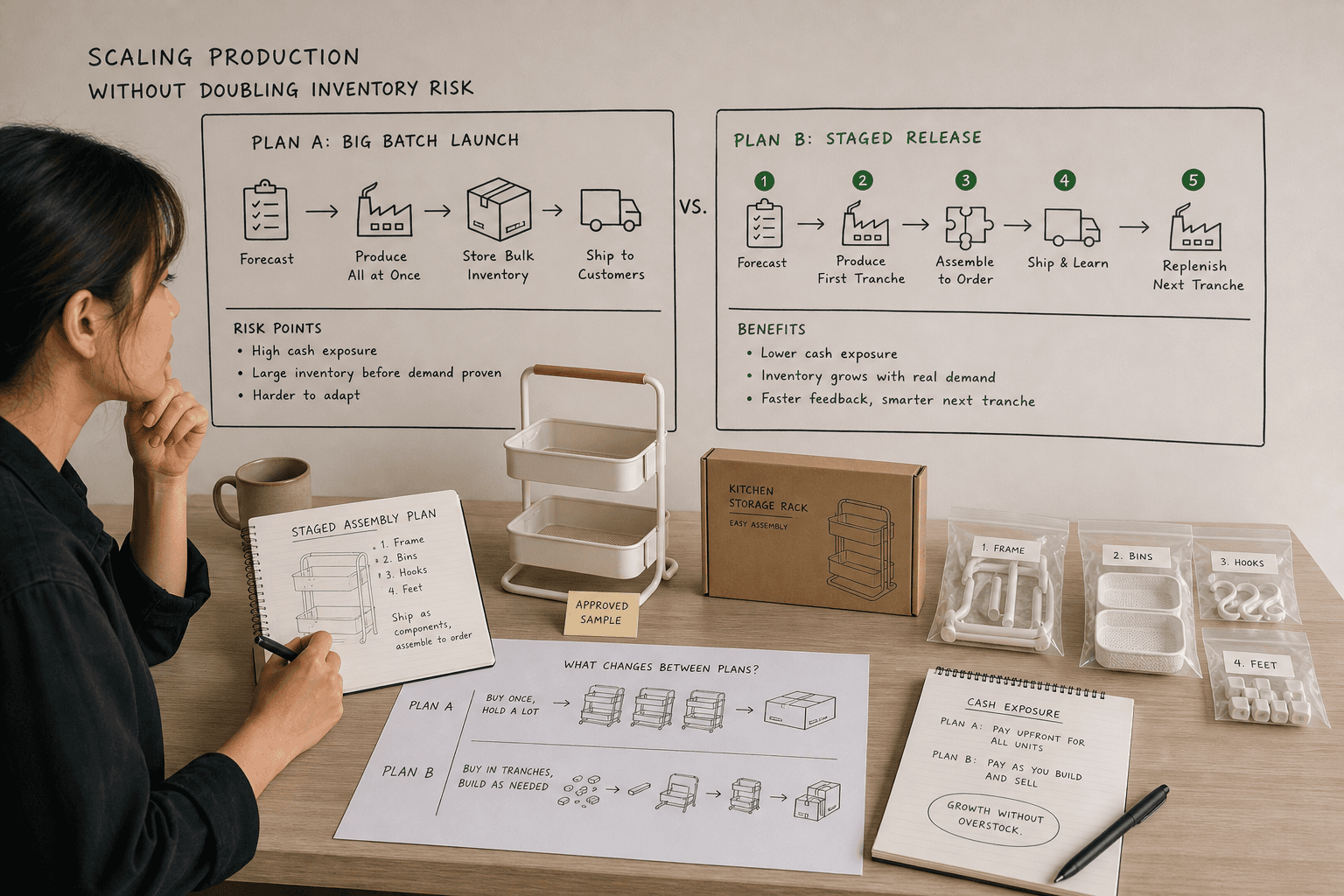
A common scaling mistake is easy to recognize after the fact. Sales improve, the factory offers a better unit price at double the volume, and the bigger PO gets approved because stockouts feel like the greater danger. A few weeks later, cash is tighter than expected, warehouse space is suddenly a topic, and the new batch is close to the approved sample but not quite the same. Close is a lovely word for horseshoes. Less so for production.
If you need to scale product manufacturing this week, the decision is not just how many units to buy. It is what to commit to first. For most ecommerce and DTC brands, the safer move is to secure supply in layers: reserve capacity, commit long-lead inputs, and delay the least reversible step, finished inventory, until demand evidence and production repeatability support it.
That is the recommendation. It changes when demand is unusually stable, replenishment lead times are long, or testing and certification rules make partial releases awkward. But those are reasons to choose a larger finished-goods commitment on purpose, not because the quote sheet made it look tidy.
The real risk is cash plus repeatability
A larger order can reduce the factory price per unit. It can also tie up more cash in the wrong form.
That matters because import value and inventory exposure are not the same as future revenue. U.S. Customs and Border Protection says the commercial invoice value should reflect the price paid or payable for the goods, not the amount you hope to sell them for later, and it notes that some additions may need to be included depending on the transaction structure (CBP on commercial invoice value). So when you double an order, you are not purchasing certainty. You are committing more cash at product cost, plus freight, duties where applicable, fees, storage, and carrying risk. If you need to rebuild that math before approving a PO, this guide on landed cost for ecommerce is the right place to start.
The second risk is process drift. The FDA's process validation guidance is written for regulated manufacturing, not as a universal legal standard for all consumer products, but its principle is useful: evidence from commercial production and continued verification matters because a process that works under one set of conditions does not automatically stay controlled when output changes (FDA process validation guidance, FDA guidance PDF). In ordinary sourcing terms, an approved sample or one good PO does not prove the line will behave the same way at a higher daily run rate, with a second shift, different operators, or more tooling wear.
That is why the sensible scaling sequence is to protect supply first and delay finished-goods exposure until you have better evidence.

Read the video transcript
When sales pick up, doubling the order can feel safer than risking stockouts, yet it often locks cash into inventory before demand and production have really proved themselves. The article's advice is to secure supply step by step: reserve capacity, buy long-lead inputs, and wait on finished units until evidence makes that exposure easier to justify. A lower factory price isn't the same as lower risk, because you're also paying freight, duties, storage, and carrying costs while process changes may quietly affect consistency. For a hypothetical kitchen storage product, reserving 6,000 units of capacity but assembling two 3,000-unit lots keeps supply moving while lot one informs lot two. Before saying yes, put demand evidence, irreversible commitments, higher-run process changes, and compliance or import readiness on one page so the tradeoffs stay visible. If you learn what becomes non-cancelable and when, you can protect supply without overcommitting, though stable demand or awkward certification rules may justify bigger finished runs.
What you need on one page before you approve the next run
Before you increase volume, gather four inputs and force them onto one page. If they do not fit on one page, they usually do not fit in your head either.
The first input is demand evidence. Look at recent weekly or monthly sell-through, reorder interval, return trend, stockout periods, and whether sales hold when promotions ease off. A brand with steady reorders from two channels is in a different position from a brand whose last eight weeks were shaped by one campaign and three out-of-stock gaps.
The second is a commitment map. You need to know what the supplier must buy or schedule now, and what can wait without breaking lead time or price. This is where many teams get sloppy, because one PO often bundles several commitments with very different risk profiles. If your quote comparison is still muddled, fix that first with a sourcing brief that gets comparable supplier replies and how to compare manufacturing quotes beyond the unit price.
The third input is process risk at the higher run rate. Ask what actually changes operationally. Same production line or a second line? Same operators or a new shift? Same tooling or added cavities? Same inspection method or a faster one? If the answer is some version of “it’s the same product, just more,” that is not yet an answer.
The fourth is compliance and import readiness. Incoterms define responsibilities between buyer and seller, but the International Trade Administration notes that they do not replace regulatory requirements (ITA on Incoterms). If tariff classification, certification, or product-rule questions are still unresolved, scaling multiplies the cost of getting them wrong.
Split the commitments before you split your cash flow
One PO usually hides several distinct commitments:
- factory capacity or line time
- long-lead materials or components
- packaging
- finished-goods assembly
- shipment timing
- release to market
These are not equally reversible. That is the whole point.
A useful supplier conversation is not “Can you handle more volume?” Nearly every supplier can answer yes with a straight face. Ask instead:
- Which materials must you purchase immediately to hold this lead time?
- Which inputs become non-cancelable once ordered?
- Can packaging stay flat, generic, or undecorated until final quantities are clearer?
- Can one materials plan support two assembly releases?
- What changes at this output level: staffing, overtime, tooling maintenance, subcontracting, or in-process inspection?
- If we split production or shipment, do MOQ economics reset?
Those answers change the decision more than broad country claims ever will. A supplier in China, Vietnam, Mexico, Portugal, or the U.S. can all be either sensible or risky depending on the product, the process, and where the quote starts and ends.
Example 1: when staged assembly beats a bigger finished-goods PO
Say you sell a private-label kitchen storage item online. Demand is established, but promotions still move volume around enough to make forecasting imperfect.
This example is hypothetical and uses illustrative assumptions, not benchmark rates.
Your current repeat order is 3,000 units. The supplier quotes:
- 3,000 units at $4.20 each
- 6,000 units at $3.85 each
The packaging is custom printed, and one core component has the longest lead time in the bill of materials. You expect to sell between 3,000 and 5,000 units over the next two months.
At first glance, the larger PO looks attractive. Factory spend would be:
- 3,000 × $4.20 = $12,600
- 6,000 × $3.85 = $23,100
If you needed all 6,000 anyway, the larger order saves $0.35 per unit, or $2,100 versus buying 6,000 units at the smaller-run price. That saving is real. It is also not the whole decision.
Now compare two paths.
Option A is one 6,000-unit finished-goods order.
Option B reserves capacity for 6,000 units, purchases the long-lead component for 6,000, and assembles in two 3,000-unit releases. Packaging is the hinge. If printed cartons must be bought in full now, your exposure is higher. If the cartons can stay generic or be staged, exposure drops.
Here is the decision logic:
| Path | Specification fit | Landed cost | MOQ | Quality risk | Internal workload | Lead time | Cash exposure |
|---|---|---|---|---|---|---|---|
| One 6,000-unit finished run | Good if spec is mature | Lower ex-factory unit price, but more inventory carrying risk | Simple | Higher if throughput changes and you find out late | Lower | Shorter once PO is placed | Highest |
| 6,000 capacity with two 3,000 releases | Good if materials and packaging can be split | May cost slightly more per delivered unit | Depends on supplier flexibility | Lower if lot one informs lot two | Higher | Slightly more planning | Lower than full finished-goods buy |
The supplier questions here should be painfully specific:
“Which materials become non-cancelable once we issue the PO, and what are their values?”
“If we reserve 6,000 units of capacity, what deposit holds the slot, and what exactly does that deposit secure?”
“Can the carton remain generic until final quantity is confirmed, or does printed packaging have to be ordered in full now?”
“If assembly is split into two 3,000-unit releases under one materials commitment, do we keep the 6,000-unit pricing?”
“What first-lot checks will you complete before lot two starts: dimensions, fit, finish, packaging drop test, or other in-process controls?”
Now add a simple hypothetical cash note. Suppose the long-lead component represents $1.10 of the $3.85 factory price, and the rest of the assembly cost is only incurred when each lot is built. Under the staged option, you might commit:
- Long-lead components for 6,000: 6,000 × $1.10 = $6,600
- First 3,000 units of remaining build cost: 3,000 × ($3.85 - $1.10) = 3,000 × $2.75 = $8,250
Initial committed factory spend before lot two would be $14,850, not the full $23,100. That is still real exposure. But it is less cash tied up in finished goods, and it buys you a checkpoint after the first lot. If demand softens, you may still own components or packaging, yet you avoid some assembly, freight, and storage on units you no longer want this quarter.
A clean decision note for this case might read: “Demand supports securing supply, but not 6,000 finished units today. Proceed if supplier can hold price and capacity with staged assembly and defined lot-one checks. If not, compare the extra $2,100 unit-price saving against the cost of carrying an extra 3,000 finished units.”
That is not heroic. It is just adult supervision for inventory.

Example 2: when compliance risk matters more than overstock risk
Now imagine a children's product preparing for a retail launch. This example is also hypothetical.
Here, the inventory logic from the kitchenware example can mislead you. The biggest risk may not be overbuying. It may be scaling a larger quantity of non-compliant stock.
The Consumer Product Safety Commission says that nearly all children's products must be tested by a CPSC-accepted third-party laboratory for applicable children's product safety requirements. It also says manufacturers and importers of general-use products subject to applicable consumer product safety rules must certify compliance in writing based on testing or a reasonable testing program (CPSC on third-party testing, CPSC on certification and testing). CPSC also states that certificate eFiling requirements apply to importers of most regulated consumer products beginning July 8, 2026, with some Foreign Trade Zone timing extending to January 8, 2027 (CPSC certificates and eFiling).
What this does not mean is that every SKU change triggers the same test path. Applicability depends on the product and the rule set. But it does mean you should not assume prior reports cleanly cover a scaled production run if materials, components, construction, or suppliers have changed.
This shifts the supplier conversation. Ask:
“Has any material, coating, substrate, trim, or subcontracted component changed since the tested sample?”
“Which production records link shipped units to the tested configuration?”
“Who prepares the certificate, on what basis, and when in the shipment process?”
“If production is split across lots or dates, can each shipment be documented correctly?”
In this scenario, the decision note may go the opposite way from the kitchenware example: “Do not release larger volume until test applicability, certification workflow, and import documentation are confirmed. The cost of waiting is lower than the cost of receiving a bigger non-compliant lot.”
That is still a scaling decision. It just happens to be governed by compliance risk before inventory risk.
When a second supplier helps, and when it mainly creates more moving parts
When one factory starts to feel tight, the next impulse is often to qualify a backup supplier. Sometimes that is exactly right. Sometimes it is a very efficient way to create spec drift, extra sample rounds, and a fresh set of unknowns.
A second supplier or second production line can reduce concentration risk and improve resilience. It can also increase qualification work, packaging variation, coordination time, and change-control burden. Compare the incumbent path and the second-source path against the same criteria: specification fit, landed cost, MOQ, quality risk, internal workload, lead time, and cash exposure. If the real constraint is your team's ability to manage more moving parts, sourcing agent vs buying direct is a more useful comparison than a generic debate about whether dual sourcing is smart.
One more thing can change the economics here: import treatment. CBP says its Binding Ruling Program allows importers to obtain pre-entry binding decisions, and that rulings can help businesses make decisions that depend on import treatment (CBP Binding Ruling Program). A ruling does not freeze every future duty outcome forever, but if your margin changes materially based on classification or origin treatment, resolve that before you scale across two supply lanes.
What the next supplier conversation should settle
If you only resolve one thing this week, resolve what becomes irreversible and when.
You need dates and values for materials, packaging, assembly, and shipment. You need to know what changes operationally at the higher run rate. You need one defined checkpoint that lot one must pass before lot two proceeds. That checkpoint should match the product. For one SKU it may be dimensional checks and finish consistency. For another it may be closure fit, seal integrity, packaging drop performance, or assembly torque. If you are still deciding whether you need to qualify the factory itself or approve a production lot, this guide on factory audit vs product inspection will help you choose the right check for the decision in front of you.
You should also confirm the commercial term being quoted. Incoterms matter, but they do not replace customs classification, valuation, or product compliance obligations (ITA on Incoterms). And if the unit-price improvement is driving the whole discussion, it is worth checking whether you are trying to lower cost in the right place. Sometimes changing packaging, spec tolerance, or MOQ structure does more than simply ordering more units. How to reduce product manufacturing costs without cutting quality covers that tradeoff well.
If you are deciding whether to reserve capacity, split production, or qualify a second supplier, AnyGoods can help compare quote boundaries, sample readiness, production constraints, and logistics tradeoffs before you commit cash to the wrong inventory. The best next step is usually to review the sourcing services or get in touch with the product, volume, and timing you are weighing.
Production and reorder planner
Connect the order milestones to the launch or reorder decision.
Build a range for uncertain dates and demand. Confirm supplier commitments and logistics requirements before relying on a timeline.
See a completed example
- Order and demand scenario
- Record SKU, order quantity, stock on hand and realistic low/base/high demand assumptions. Note where demand data came from.
- Before production
- List specification freeze, sample approval, materials, tooling and deposit milestones, with owners and dependencies.
- During production
- Record production start, check-in dates, inspection points, change approval and the latest date for escalation.
- Before shipment
- Confirm inspection release, balance payment, packing data, carton labels, bookings and destination receiving requirements.
- Delivery and receiving
- Plan transit, customs clearance, fulfillment appointments and inventory availability. Keep estimates distinct from confirmed dates.
- Reorder decision
- Estimate demand during replenishment lead time and add a justified uncertainty allowance. Document the evidence that will trigger the next order.
- Contingency
- Name the specific delay or shortage risk and its response. Compare split shipments, alternate materials or a second supplier on cost and fit.
Make your own brief
Your entries stay in this tab. Download before leaving; they are not saved or sent to AnyGoods.
Sources & further reading
- CBP: What value should be on the commercial invoice submitted to U.S. Customs and Border Protection?help.cbp.gov
- FDA: Process Validation: General Principles and Practicesfda.gov
- FDA: Process Validation: General Principles and Practices PDFfda.gov
- International Trade Administration: Know Your Incotermstrade.gov
- CPSC: Third Party Testing Guidancecpsc.gov
- CPSC: General Use Products Certification and Testingcpsc.gov
- CPSC: Certificates of Compliance and eFilingcpsc.gov
- CBP: Binding Ruling Programhelp.cbp.gov
Published by AnyGoods Editorial. Updated .