
You usually don't ask about sourcing agent vs direct manufacturer at the calm, sensible stage.
You ask when three quotes are on your desk, none of them cover quite the same thing, one supplier has gone vague on packaging, and someone internally wants to place the PO before the holiday shutdown. That is the moment this decision matters, because the wrong route doesn't just annoy you. It ties up cash in inventory you may need to rework, relabel, discount, or explain to customs.
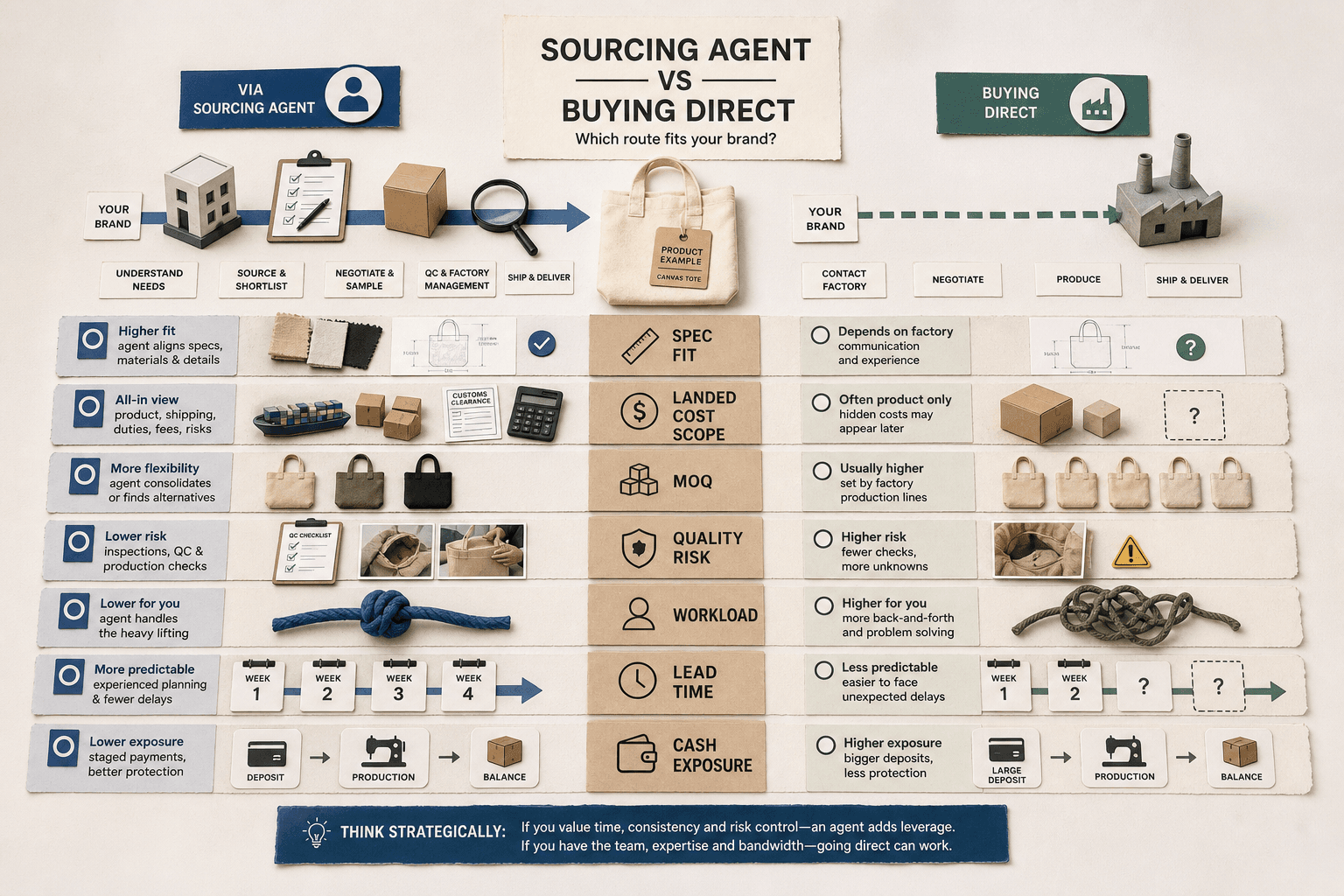
Here's the recommendation up front. Buy direct when the spec is already clear, the supplier shortlist is credible, and your team can run the process from quote comparison through production follow-up without dropping a live grenade into logistics or compliance. Use a sourcing agent when the main cost is coordination failure: first runs, custom packaging, supplier changes, low leverage with factories, or products where documentation and market-entry obligations are easy to get wrong.
The important tradeoff is not fee versus no fee. It's whether "direct" is actually simpler once you count quote quality, internal workload, landed-cost visibility, and the amount of cash at risk before you know the order is right.
If you're still trying to turn an idea into something suppliers can quote consistently, fix that first. How to source your first product covers the brief, and how to find a manufacturer for your product and compare the right factories goes deeper on building a shortlist you can actually evaluate.
Start with one question: who can control the brief?
This is the first thing to settle because it changes the rest of the decision.
If your team can define the product in production terms, direct buying usually has the edge. If you can't, an agent may be worth more than their fee before you ever get to production. The issue is not factory access. It's whether every supplier is quoting the same item, to the same packaging standard, with the same assumptions about testing, labeling, samples, and handoff.
A decent brief includes materials, dimensions, finish, tolerances where they matter, packaging, labeling, destination market, test needs, and acceptable substitutions. That sounds obvious. It is also where a lot of supposedly cheap direct deals start going wrong.
NIST's supplier evaluation guidance is useful here for one narrow reason: it stresses specifications, communicated requirements, acceptance criteria, and inspection or validation before use, and it notes that accreditation or registration alone does not guarantee acceptable quality in your application (NIST supplier evaluation procedure). It doesn't prove that an agent performs better than your team. It does support the less glamorous truth that process discipline matters more than factory folklore.
So ask yourself a blunt question. Can someone on your side tell whether Supplier A and Supplier B are quoting the same thing, or are you mostly hoping they are?
Read the video transcript
When quotes don’t match, packaging is fuzzy, and a shutdown is looming, the real problem isn’t annoyance. It’s tying up cash in inventory you may need to fix later. Buying direct works when your team can define the product clearly and manage follow-up. An agent helps when confusion and coordination gaps are more dangerous than the fee. A low unit price can mislead if labeling, samples, trade terms, or packaging aren’t aligned. You need the same scope, because hidden gaps become real costs. Imagine a 3,000-unit private-label personal care accessory. Supplier A looks cheapest until packaging, barcode labeling, and another sample round raise its adjusted cost above Supplier B. Before committing, get the included scope in writing, confirm where cost and risk transfer, and name the exact sample governing production for inspections. Direct is cleaner once the product, packaging, and supplier are already stable. But compliance and market-entry responsibility still need clear ownership, so certainty matters more than appearances.
Factory price is the wrong comparison if quote scope is uneven
This is where most bad decisions dress up as cost discipline.
A proper comparison needs the same criteria on both routes: specification fit, landed cost visibility, MOQ, quality risk, internal workload, lead time, and cash exposure. If you only compare unit price, you are not comparing routes. You are comparing the shortest number in the email.
For U.S. imports, customs value is based on the price paid for the goods rather than your resale price, and CBP notes that declared value can include items such as selling commissions, assists, royalties, production costs, packing, and proceeds where applicable (CBP commercial invoice value guidance). CBP also distinguishes customs value from freight and insurance in typical transaction-value treatment (CBP CIF duty guidance). That doesn't tell you which supplier is best. It does tell you that a shallow unit-price comparison is not enough.
Trade terms matter just as much. Incoterms allocate buyer and seller obligations differently, including delivery points and risk transfer (ICC guide to Incoterms 2020; ICC Incoterms Q&A). If one quote leaves you handling more of the movement and another carries the goods further along the chain, those are not comparable offers even if the unit prices look close.

Example 1: a first private-label launch where the route changes with quote quality
This example is hypothetical.
Say you sell a personal care accessory online and want a first private-label run of 3,000 units with custom retail packaging.
You collect three quotes:
- Supplier A: $2.10 per unit, plain inner pack, barcode labeling excluded
- Supplier B: $2.28 per unit, retail carton upgrade included, one extra sample round included
- Supplier C: $2.04 per unit, but on a different trade term and with more shipping coordination left to you
Assume these added costs to make Supplier A comparable:
- Packaging upgrade: $0.14 per unit
- Barcode labeling: $0.03 per unit
- Extra sample round: $120 total
Now do the arithmetic.
Hypothetical adjusted cost for Supplier A before freight, duty, tax, and inspection:
- Base unit price: $2.10
- Packaging upgrade: $0.14
- Barcode labeling: $0.03
- Extra sample round allocated across 3,000 units: $120 / 3,000 = $0.04
- Adjusted pre-freight cost: $2.31 per unit
At that point, Supplier A is no longer the cheapest fully described option. Supplier C might still be competitive, but only after you normalize the trade term and the work left on your side.
This is the kind of situation where an agent may earn the fee. Not because agents possess magical factories hidden behind a curtain, but because someone needs to force comparability before you commit cash.
If you stay direct, your next supplier email should settle the missing scope in writing. Useful questions:
- Please itemize everything included in the unit price: product, inner pack, retail carton, inserts, master carton, barcode application, and labels.
- Which trade term is this quote based on, and where exactly do cost and risk transfer?
- Which sample will govern production: current sample, revised sample, or signed golden sample?
- What product documentation, test support, or labeling support can you provide for our destination market, and what remains our responsibility?
- What is driving the MOQ: material purchasing, packaging setup, tooling, or line changeover?
Notice what changed the recommendation here. It wasn't inexperience in the abstract. It was uneven quote scope and a high chance that a founder-led team would approve a supplier before the comparison was honest.
Buy direct when the product is already under control
Direct buying usually makes sense when the expensive learning work is behind you.
That means the spec is stable, the approved sample is trustworthy, packaging is settled, the target market is unchanged, and someone on your team can manage replenishment timing, QC decisions, and freight handoff. In that situation, adding another coordination layer may create more communication than value.
Example 2: a repeat order where direct is usually the cleaner route
This example is hypothetical.
Say you sell an insulated stainless steel bottle and have already completed one successful production run. The factory has met your standard on finish, leak testing, carton spec, and barcode placement. You are now placing a reorder for the same market.
Here, direct usually fits better.
You already have the bones of control: approved sample, packaging dielines, acceptance points, and a known supplier. Your risk is less about finding a capable factory and more about making sure nothing has quietly changed.
That shifts what you inspect.
Instead of asking broad sourcing questions, ask decision questions tied to the repeat run:
- Has any component source changed since the approved production run, including lid gasket, coating, or carton board?
- Will the same production line and process controls be used?
- Has the lead time changed because of capacity or material availability?
- What in-line and pre-shipment checks will be performed against the approved sample?
- If there is a substitution request, which exact spec line is changing and what sample evidence will show equivalence?
Suppose the factory confirms the same gasket, same coating, same carton, same market, and the same trade term as the last order. In that case, direct buying is likely the better route because your internal team can review the delivery against known standards.
Now carry that same example one step forward. Imagine the sales team wants a retail launch and asks for a new gift box, a revised color finish, and a claim on domestic assembly for a future U.S. marketing push. Suddenly this is not the same reorder anymore. Packaging, finish consistency, and origin-claim substantiation all need fresh scrutiny. At that point, bringing in outside sourcing support may be sensible again if your internal team can't absorb the change cleanly.
That is the pattern worth remembering: once uncertainty rises again, direct loses part of its advantage.
Compliance sits with the market-entry role, not with your optimism
This is the part buyers often leave fuzzy because it slows down the fun part.
Buying direct does not transfer your importer or market-entry responsibilities to the factory. A factory may provide documents, test reports, or label support. That is useful. It is not the same as taking legal responsibility for your sale into a destination market.
For imported finished products under U.S. CPSC certificate rules, the importer responsible for certificates is generally the Importer of Record eligible to make entry (CPSC GCC FAQ). In the EU, the General Product Safety Regulation framework requires a responsible economic operator in the EU for covered products and sets obligations on safety, documentation, traceability, and corrective action for manufacturers and importers (EUR-Lex GPSR summary).
Those sources do not mean every product needs the same testing or paperwork. They do mean you should not let a supplier conversation drift into "they said they can handle compliance" without pinning down what that actually means for your product and market.
The same caution applies to origin claims. If you are considering U.S. manufacturing or final assembly for brand positioning, the FTC says unqualified "Made in USA" claims require the product to be "all or virtually all" made in the U.S., and final assembly alone is not enough (FTC Made in USA guidance). That's a marketing and substantiation issue, not a sourcing vibe.
An agent doesn't automatically solve any of this. But a good one should force the right ownership questions early instead of letting them surface after samples, freight booking, or retail onboarding.
Lead time is really a reliability question
Neither route is always faster.
Direct can be faster when the factory is known, the brief is settled, and your team answers quickly. An agent can be faster when your alternative is spending two weeks chasing partial answers from five suppliers and then discovering the quotes were never comparable.
The useful research point here is narrow. The World Bank's logistics framework treats customs efficiency, infrastructure, shipment arrangement, service quality, tracking, and timeliness as separate parts of logistics performance, not one freight-price number (World Bank logistics methodology; LPI 2023 release). That does not tell you the best country for your SKU, and it does not prove an agent will shorten production lead time. It does support a buying decision: don't assume the lowest visible freight line means the lowest delivery risk.
The tradeoff that should change your choice: cash exposure
If you're stuck between the two routes, use cash exposure as the tie-breaker.
Ask three things.
How much cash is committed before you know the order truly works? Which assumptions could make that cash vulnerable: packaging errors, weak samples, wrong labeling, quality drift, or a compliance gap? And does your chosen route reduce those risks or simply hide them until later?
This is why "agents cost money" is not a complete objection. Of course they do. The question is whether their fee is smaller than the cost of a bad first run, a slow rework cycle, or a reorder you can't place confidently because the first order taught you too little.
The reverse is also true. If your product is stable and your team is capable, paying for an extra layer can become expensive ceremony.
What your next supplier conversation should resolve this week
Don't leave this article with a philosophical preference. Leave with a narrower decision.
In your next call or email, settle four points before you choose the route.
First, lock the quote scope. Ask for a line-by-line statement of what the price includes: product, packaging, labels, inserts, cartons, tooling, sample rounds, and any documentation support.
Second, lock the handoff. Confirm the quoted trade term and the exact point where cost and risk transfer. If two quotes use different terms, treat them as different offers, because they are.
Third, lock the production reference. Confirm which approved sample governs production and what you'll inspect if the run drifts. Inspect findings that change decisions: substitutions in material or component source, finish variation, fit issues, labeling accuracy, carton strength, and any product-specific test result required for your market.
Fourth, lock the ownership of market entry. Ask what the supplier can provide, what still needs independent verification, and who remains responsible as importer or economic operator.
If you can answer those points confidently with your own team, direct buying is probably the right route. If those answers are still slippery and the PO cannot wait forever, this is exactly where outside coordination can pay for itself. If that is the problem on your desk this week, AnyGoods can help compare supplier quotes, manage samples, and coordinate production and logistics without taking over your factory relationship. See the process at /#process or start a conversation at /#contact.
Supplier quote comparison
Put competing quotes on a common basis before choosing a factory or negotiating an existing SKU.
These fields organize a comparison; they do not calculate taxes or replace a current freight quote. Mark every estimate and its date.
See a completed example
- Common specification
- Use the same drawing revision, materials, approved reference, quantity and packaging requirements for every supplier.
- Unit price and setup costs
- Supplier A / B / C: unit price, currency, MOQ, tooling, sample fees, setup fees and what is excluded.
- Delivery basis and logistics
- Record the exact Incoterm, version and named place. Separately record freight, insurance, brokerage and destination handling assumptions.
- Landed-cost assumptions
- Itemize applicable verified duties, shipping and nonrecoverable fees. Divide order-level costs by the relevant sellable units. Separate recoverable taxes from expense assumptions.
- Quality and lead time
- Compare tests, inspection scope, acceptable variation, sample approval, production lead time and capacity evidence.
- Cash and risk
- Record deposits, balance timing, currency exposure, inspection remedies and cost of financing or storing extra units.
- Retail pricing context
- Record net selling price, discounts, payment fees, fulfillment, returns and acquisition-cost assumptions separately. Calculate contribution using a clearly defined denominator.
- Decision and open questions
- State which option you favor and why. List unresolved assumptions that could reverse the decision before you approve the order.
Make your own brief
Your entries stay in this tab. Download before leaving; they are not saved or sent to AnyGoods.
Sources & further reading
- General Certificate of Conformity (GCC) FAQcpsc.gov
- What value should be on the commercial invoice submitted to U.S. Customs and Border Protection?help.cbp.gov
- Duty - Cost Insurance and Freight (CIF)help.cbp.gov
- Complying with the Made in USA Standardftc.gov
- ICC Guide to Incoterms® 20202go.iccwbo.org
- ICC Digital Library: Incoterms Q&A 2020library.iccwbo.org
- General product safety regulation (2023)eur-lex.europa.eu
- Procedure for Purchasing and Supplier Evaluationnist.gov
- Glossary | DataBankdatabank.worldbank.org
- World Bank Releases Logistics Performance Index 2023worldbank.org
Published by AnyGoods Editorial. Examples are illustrative unless a source is identified. Updated .