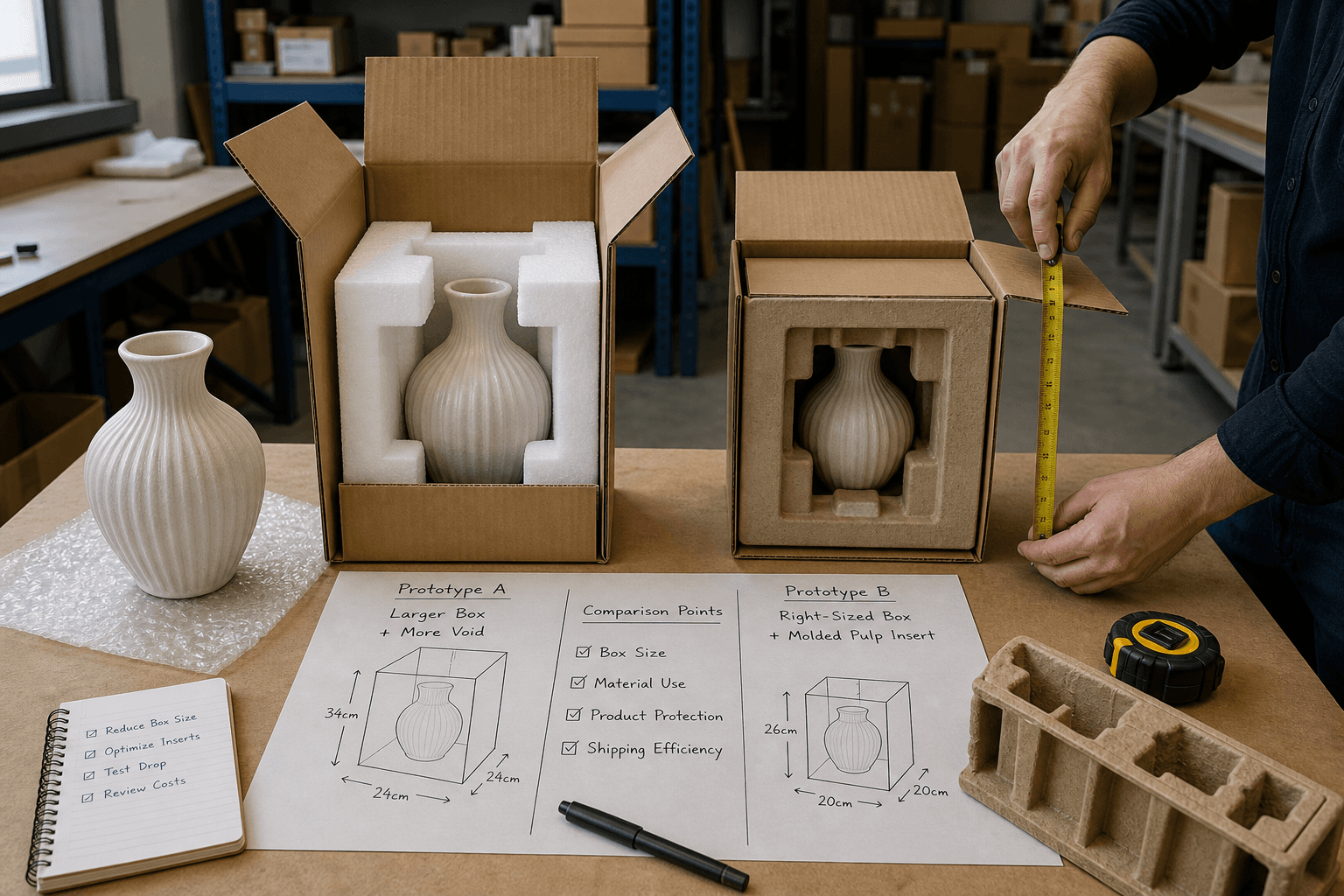
A common way to lose money on a decent product is to approve the order when the factory quote looks fine, then discover you never had a comparable quote in the first place.
One supplier priced EXW. Another priced FOB. One included the retail insert and export cartons. The other did not. Freight was penciled in as ocean, then changed to air because the launch date got ambitious. Duty was based on a supplier's casual HS code suggestion, which is not the same thing as a classification decision. The unit price looked cheaper. The order was not.
That is the point of a proper landed cost calculation ecommerce model. It is a gate before the PO, not a forensic exercise after the money has gone out. If two offers are not normalized to the same commercial boundary, you are not comparing suppliers. You are comparing different bundles of work, risk and assumptions.
The number you actually need
For this decision, landed cost means total cost per sellable unit to get compliant goods to your receiving point under the shipment plan you expect to use.
That can include factory price, packaging, inserts, origin charges you must pay, main freight, insurance where relevant, duty, customs user fees, brokerage, destination handling, and testing or certification work that is required to make the unit importable and saleable. CBP is quite clear that imported goods may be subject to duty, taxes and user fees, which is why factory price alone is not a landed number (CBP import duty, taxes and fees overview).
The model does not have to predict every cent perfectly. It does have to compare offers on the same basis. If your quotes are still a mix of missing packaging, vague Incoterms and guessed freight assumptions, fix that before you debate which supplier is “better.” This guide pairs well with how to compare manufacturing quotes beyond the unit price, because the math is only as good as the quote boundary you set.
Read the video transcript
A factory quote can look safely profitable, then unravel after approval because shipping terms, packaging, freight mode, and duties weren’t actually being compared on the same basis. The article’s point is simple: build landed cost before the purchase order, so each offer reaches the same receiving point as one sellable, compliant unit. That means locking what’s included, the named Incoterm place, tariff assumptions, compliance needs, and cash terms, because each one shifts risk and total cost. In the bottle example, Supplier A lands lower per unit after adding missing inserts, origin handling, freight, duty, and fees, yet needs a bigger first order. If classification or children’s-product compliance is still unclear, don’t force a decision; those unknowns can decide whether goods are even import-ready, not just profitable. Use one shared model and a short decision note beside each quote, then pick the option whose landed cost, workload, and cash demands still fit your launch.
Fix these five inputs before you compare anything
Start with commercial scope. Ask what is included in the quoted unit price and what is not. That means retail box, insert, barcode label, export carton, palletization, tooling, artwork setup, export documents and inspection support. If one factory includes half the pack-out and the other does not, the lower line item is just tidier camouflage.
Next, lock the Incoterm and named place. Incoterms allocate responsibilities for carriage, documents, insurance and customs formalities between seller and buyer (ICC Incoterms guidance). A quote on EXW is not directly comparable with a quote on FOB or DDP until you rebuild them to the same point. ICC's own checklist also warns that EXW is primarily suitable for domestic trade and can create practical difficulties in international use (ICC Incoterms checklist). That does not make EXW forbidden. It does mean a small team should not treat it as free savings.
Then fix the tariff basis. In the U.S., duty depends on the product's classification in the Harmonized Tariff Schedule maintained by USITC (USITC Harmonized Tariff Information). There is no universal duty rate for “ecommerce products.” Material, construction, intended use and origin can change the result. If the classification is unresolved, your landed cost is unresolved in a way that can absolutely change the buying decision.
Fourth, fix the compliance basis. Some products can move ahead with ordinary documentation and sensible testing support. Others cannot. For general-use consumer products subject to CPSC rules, manufacturers and importers must certify compliance, and the CPSC explains that testing or a reasonable testing program may be required depending on the product (CPSC general-use certification and testing). Many children's products require third-party testing by a CPSC-accepted lab and a Children's Product Certificate; CPSC also states that, from July 8, 2026, importers of most regulated consumer products must eFile certificate data with CBP (CPSC children's product testing rules). That does not mean every SKU needs the same lab work. It does mean “we'll sort that out later” is not a cost model.
Last, fix the cash basis. MOQ, deposit terms, production lead time and freight mode decide how much cash is tied up before you can sell a unit. Lower landed unit cost can still be the wrong choice if it forces too much inventory into a first run or leaves you one freight delay away from an expensive stockout.
Worked example 1: the lower unit price does not win by default
Here is a hypothetical example using illustrative assumptions only, not benchmark rates.
Say you sell a private-label insulated bottle and you are choosing between two factories for a first production run.
Supplier A quotes $4.20 per unit on EXW terms, with a 3,000-unit MOQ. Inserts are not included.
Supplier B quotes $4.42 per unit on FOB named port terms, with a 2,000-unit MOQ. Inserts are included.
At first glance, A looks cheaper. That is where people get into trouble.
Before deciding, ask both suppliers the same questions:
- What exactly is included in the unit price?
- Which Incoterm and named place does the quote use?
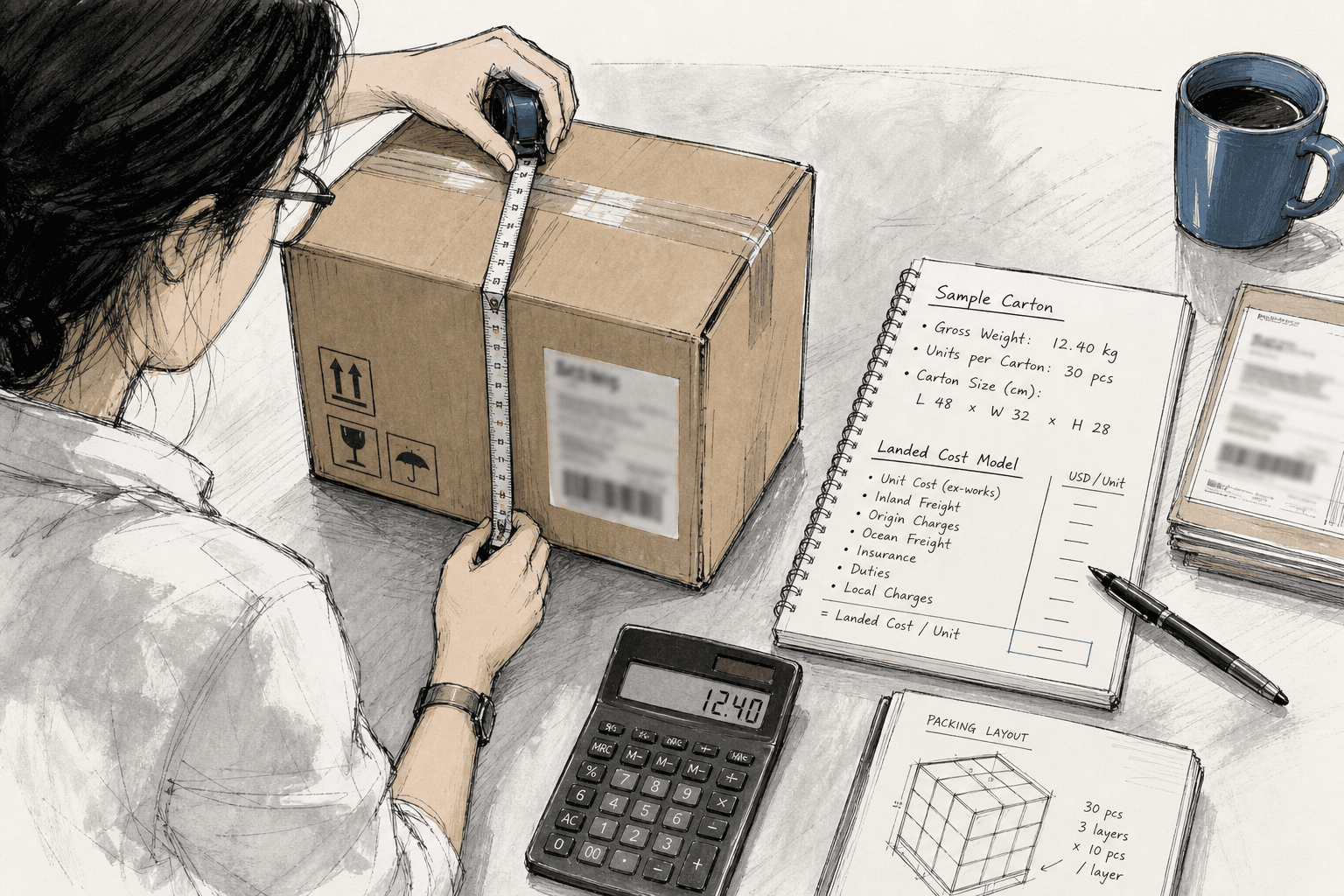
- What are carton dimensions, gross weight and units per carton for this exact pack-out?
- Are inserts, barcode labels, export cartons and palletization included?
- What readiness date applies to this quantity?
Then ask your broker a separate set of questions:
- Based on this exact product description and material construction, what HTS classification should we model?
- Will this shipment likely be a formal entry?
- Which fees should we include under this route and mode?
Now normalize both quotes. Assume the following for comparison only:
- Supplier A insert cost: $0.08 per unit
- Supplier A origin pickup and export handling under EXW: $420 per shipment
- Main freight and destination charges: $1,300 total for A, $1,180 total for B
- Customs broker and admin: $180 per shipment for both
- Provisional duty assumption: 5% for both, pending classification confirmation
- Both shipments enter the U.S. as formal entries by ocean
CBP states that for FY2026 the Merchandise Processing Fee for formal entries is 0.3464% of imported goods value excluding duty, freight and insurance, subject to a minimum of $33.58 and a maximum of $651.50 (CBP Merchandise Processing Fee guidance). CBP also states Harbor Maintenance Fee is 0.125% of cargo value for certain cargo moving through U.S. ports and is not collected on air imports (CBP Harbor Maintenance Fee guidance). Since this scenario uses ocean-port cargo, include HMF here.
For Supplier A:
Goods value = 3,000 × $4.20 = $12,600
Missing inserts = 3,000 × $0.08 = $240
Origin handling = $420
Freight and destination charges = $1,300
Duty = 5% × $12,600 = $630
MPF = 0.3464% × $12,600 = $43.65
HMF = 0.125% × $12,600 = $15.75
Broker and admin = $180
Total landed shipment cost = $12,600 + $240 + $420 + $1,300 + $630 + $43.65 + $15.75 + $180 = $15,429.40
Landed unit cost = $15,429.40 ÷ 3,000 = $5.14
For Supplier B:
Goods value = 2,000 × $4.42 = $8,840
Inserts included = $0 extra
Origin handling under FOB = $0 extra in this simplified comparison
Freight and destination charges = $1,180
Duty = 5% × $8,840 = $442
MPF minimum applies because 0.3464% × $8,840 = $30.62, below the minimum, so use $33.58
HMF = 0.125% × $8,840 = $11.05
Broker and admin = $180
Total landed shipment cost = $8,840 + $1,180 + $442 + $33.58 + $11.05 + $180 = $10,686.63
Landed unit cost = $10,686.63 ÷ 2,000 = $5.34
On landed unit cost alone, Supplier A wins: $5.14 versus $5.34.
Now keep going, because this is where adults stay in the room.
Supplier A also requires 1,000 more units on the first run. That means more deposit cash, more inventory on hand before you know how the product will actually move, and more internal coordination because EXW leaves more origin-side work with the buyer. Supplier B costs $0.20 more per landed unit in this model, but ties up less cash and asks less from the team.
If you sell the bottle at a hypothetical $24 retail, the landed-cost gap between the two options is 2,000 or 3,000 units multiplied by $0.20 per unit. For the comparable 2,000-unit portion, that gap is $400. The extra 1,000 units required by Supplier A add another $5,140 in landed inventory exposure before you have sales data for those units. That does not make A wrong. It does show the real tradeoff.
A sensible decision note might read like this: approve Supplier A only if the team can manage EXW cleanly and the extra inventory cash does not crowd out marketing, reorder flexibility or packaging fixes after the first run. Choose Supplier B if preserving cash and reducing coordination risk matter more than shaving $0.20 from landed cost.
That is the recommendation most readers actually need. Not “always choose the lowest landed unit cost.” Choose the option whose landed cost still makes sense once you include the cash and workload it creates. If you want to push on cost without quietly increasing quality risk, how to reduce product manufacturing costs without cutting quality covers the right levers.
Worked example 2: when the right answer is to stop
Some uncertainty is harmless. Some uncertainty means you do not approve the PO yet.
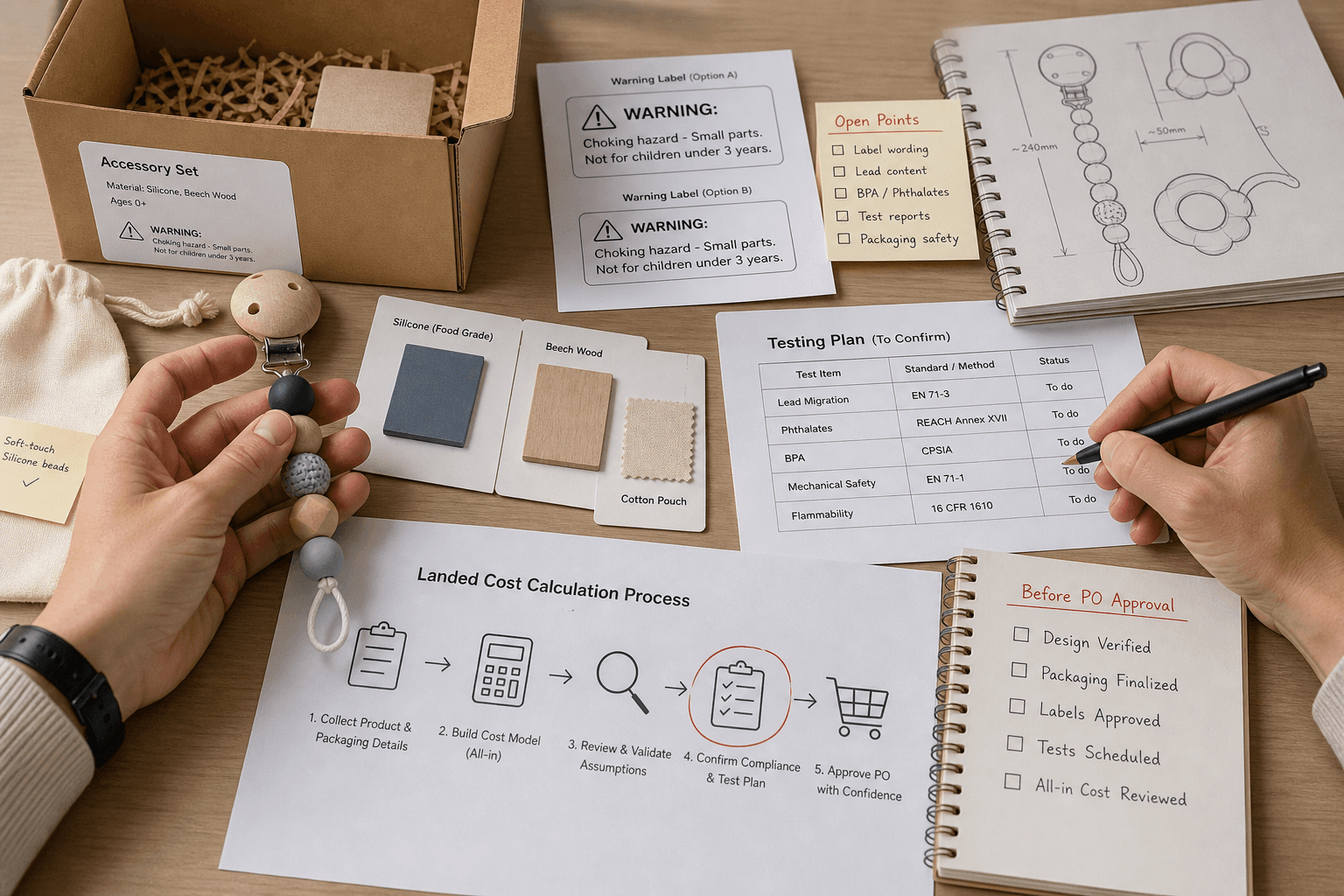
For example, imagine you sell a children's accessory set and a supplier sends an all-in estimate that looks close enough to your retail target. The quote may even include freight assumptions. Fine. You still do not know the final HTS classification, whether the components should be treated the way the supplier thinks they should, which children's product rules apply, what third-party testing is required, who will prepare the certificate data, or whether your import process is ready for eFiling.
At that point, your landed model is not unfinished in a harmless way. It is missing the parts that determine whether the goods are import-ready at all.
The supplier questions here should be specific:
- Please provide the full bill of materials and material breakdown for each component.
- Which age grading and intended use are you assuming for this product?
- What existing test reports relate to this exact construction, if any?
- What labels, warnings and tracking information are included in the current pack-out?
- What compliance documents will you provide, and what remains with the importer?
Your compliance or broker questions should be equally blunt:
- Based on this exact product description, what classification should we model?
- Does this product fall under children's product requirements that trigger third-party testing?
- What documentation must be ready before import?
- What lead time should we allow for testing, certificates and filing readiness?
The recommendation here is simple: do not approve the order yet. Confirm the compliance path, then rebuild the landed model with real testing, documentation and timing assumptions. That is slower than clicking approve today and much faster than remaking packaging, retesting, or finding out the shipment is not ready for entry after production is complete.
What the research changes, and what it does not
The useful finding from the source material is not that imports have costs. You knew that already. The revealing part is where those costs become decision-changing.
CBP's published MPF minimum means smaller formal-entry shipments can carry a higher per-unit fee burden than a quick percentage estimate suggests (CBP MPF guidance). HMF applies on certain port cargo and not on air imports, so mode matters in a very literal way (CBP HMF guidance). ICC's guidance makes clear that changing the Incoterm changes who is responsible for key parts of transport and customs handling, which means you cannot treat EXW, FOB and DDP as cosmetic wording changes (ICC Incoterms guidance). CPSC's rules show that compliance costs and timing can be part of the pre-PO decision, especially for children's products (CPSC children's product testing rules).
The limits matter too. None of those sources tells you the correct classification for your SKU, the exact duty rate your product will carry, or the exact test plan your product needs. They tell you which assumptions must be resolved before you place the order with a straight face.
When each route makes sense
Handling this in-house works when your team already manages freight, customs, testing and production follow-up, and the product is straightforward enough that the unknowns are small.
Taking a higher-service supplier quote can make sense when the supplier is transparent about what sits inside the price and you are comfortable giving up some control. DDP may simplify operations, but it can also hide assumptions about classification, fees and import handling. Hidden cost is still cost. It is just wearing a cleaner shirt.
Outside sourcing support makes sense when the hard part is not finding one quote, but forcing several inconsistent quotes into a fair comparison, checking supplier reliability, and keeping production details, quality scope and logistics assumptions tied to the same decision. If that is the issue this week, AnyGoods can help compare quotes and coordinate the process before you commit the order. If you are still deciding whether to manage this directly or bring in help, sourcing agent vs buying direct is the more useful comparison than another round of wishful spreadsheet edits.
Build one model and make one decision note
Before you approve the PO, put each viable quote into the same model with these fields at minimum: spec version, unit price, MOQ, Incoterm and named place, included packaging, carton dimensions and weights, tooling or setup costs, country of origin, HTS assumption, compliance assumptions, freight mode, duties and fees, total landed shipment cost, landed unit cost, cash out before receipt, and weeks from deposit to receipt.
Then write one sentence beside each option explaining what would change the decision.
If the model still depends on a guessed tariff code, undefined pack-out or unexplained compliance assumptions, do not approve the order this week. Resolve those points first. That is your next move.
Supplier quote comparison
Put competing quotes on a common basis before choosing a factory or negotiating an existing SKU.
These fields organize a comparison; they do not calculate taxes or replace a current freight quote. Mark every estimate and its date.
See a completed example
- Common specification
- Use the same drawing revision, materials, approved reference, quantity and packaging requirements for every supplier.
- Unit price and setup costs
- Supplier A / B / C: unit price, currency, MOQ, tooling, sample fees, setup fees and what is excluded.
- Delivery basis and logistics
- Record the exact Incoterm, version and named place. Separately record freight, insurance, brokerage and destination handling assumptions.
- Landed-cost assumptions
- Itemize applicable verified duties, shipping and nonrecoverable fees. Divide order-level costs by the relevant sellable units. Separate recoverable taxes from expense assumptions.
- Quality and lead time
- Compare tests, inspection scope, acceptable variation, sample approval, production lead time and capacity evidence.
- Cash and risk
- Record deposits, balance timing, currency exposure, inspection remedies and cost of financing or storing extra units.
- Retail pricing context
- Record net selling price, discounts, payment fees, fulfillment, returns and acquisition-cost assumptions separately. Calculate contribution using a clearly defined denominator.
- Decision and open questions
- State which option you favor and why. List unresolved assumptions that could reverse the decision before you approve the order.
Make your own brief
Your entries stay in this tab. Download before leaving; they are not saved or sent to AnyGoods.
Sources & further reading
- ICC Incoterms 2020 Q&Alibrary.iccwbo.org
- USITC Harmonized Tariff Informationusitc.gov
- CBP: Duty, Taxes and other Fees required to import goods into the United Stateshelp.cbp.gov
- CBP: Merchandise Processing Feeshelp.cbp.gov
- CBP: Harbor Maintenance Feehelp.cbp.gov
- ICC Incoterms 2020 checklistlibrary.iccwbo.org
- CPSC General Use Products: Certification and Testingcpsc.gov
- CPSC Rules Requiring Third-Party Testing and a Children's Product Certificatecpsc.gov
Published by AnyGoods Editorial. Examples are illustrative unless a source is identified. Updated .