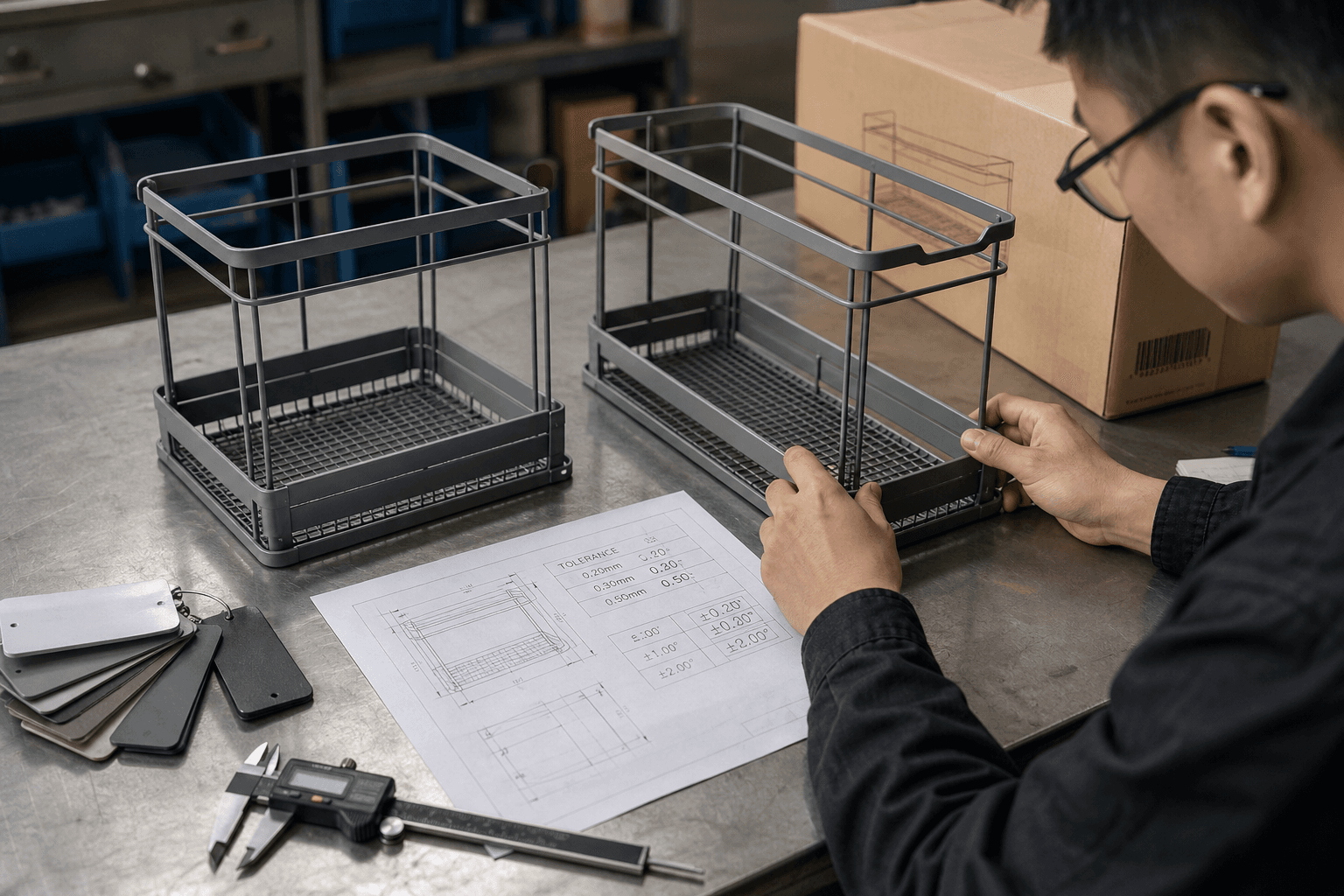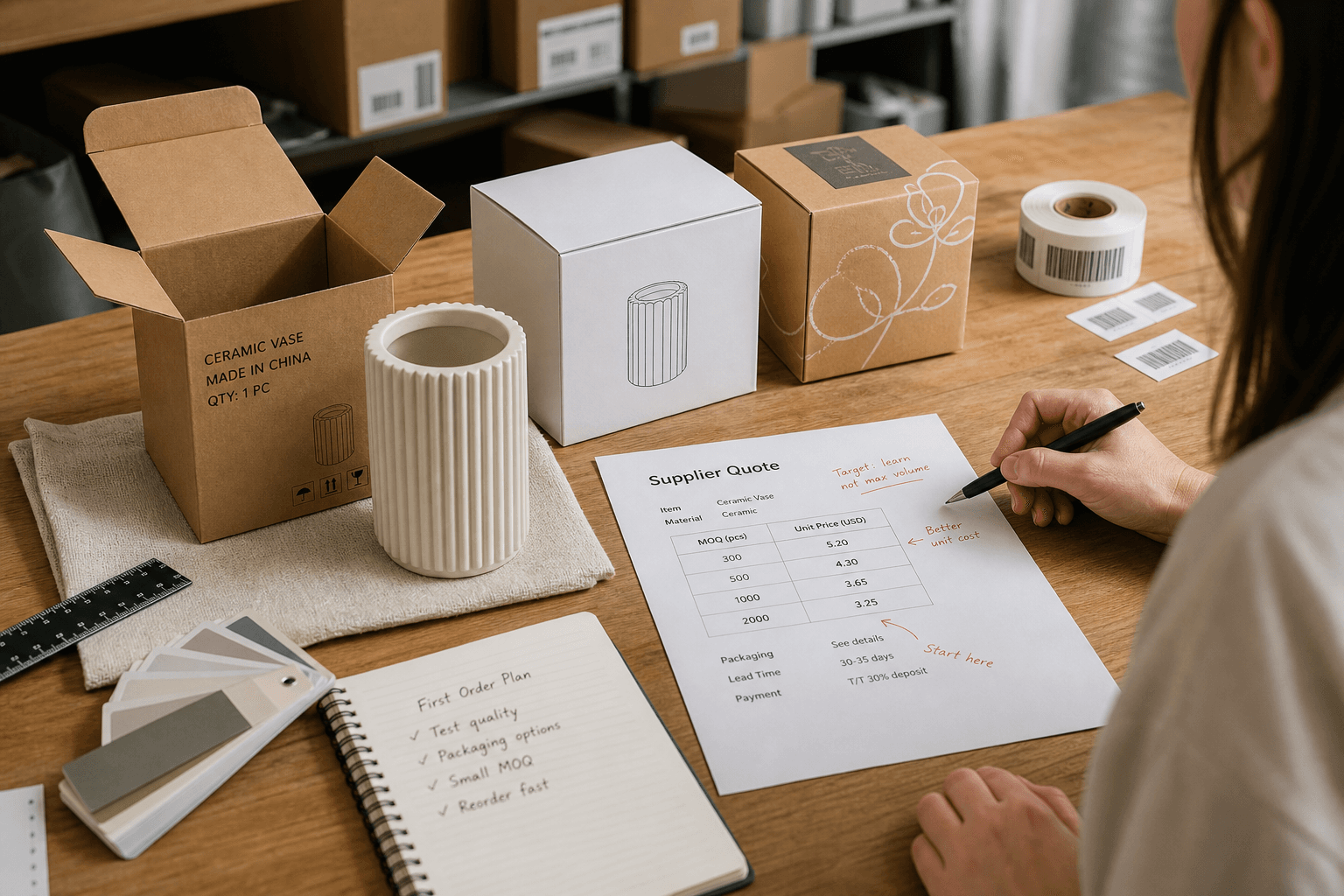
A familiar mistake goes like this: you get a quote with a 3,000-unit MOQ, ask for 500, hear “no,” and decide the factory is being difficult.
Sometimes it is. Quite often, though, you’re negotiating the wrong thing.
If you want to negotiate minimum order quantity without buying a warehouse full of regret, treat MOQ as a bundle of commitments, not one blunt number. Some parts are real production economics. Some come from packaging choices you added. Some are supplier policy. Some sit outside the factory because the carton printer, fabric mill, or bottle vendor has its own minimum. Your first production order should be big enough to produce a reliable result and small enough to survive being wrong.
That leads to a simple recommendation: for a first PO, keep the product close to a proven base spec and move non-recurring costs out of the unit quantity wherever possible. This works best for stock or lightly customized products using standard materials and packaging. I’d choose differently if the product depends on custom molds, regulated testing, unusual materials, or elaborate packaging, because then part of the minimum may be real and unavoidable.
The decision is not “Can you lower the MOQ?”
The real question is: which commitments do you need to make now to get a reliable first run, and which can wait until demand is proven?
Before you counter an MOQ, separate it into three buckets.
First, setup work that happens before production starts: tooling, print plates, color matching, lab work, package artwork, pre-production samples, or compliance documents.
Second, minimum purchases for components and materials: resin, fabric, labels, inserts, corrugate, pumps, lids, zipper pulls, or decorated cartons.
Third, factory efficiency: line time, changeovers, scheduling, carton pack counts, and the supplier’s preference for larger runs.
Those buckets should not be negotiated the same way. A one-time setup cost can often be paid separately. A material minimum may shrink if you standardize the spec. A scheduling preference may justify a higher unit price for a small run, but not necessarily a giant opening order.
This matters because your cash exposure is not the ex-works unit price alone. U.S. Customs and Border Protection says commercial invoices for entry need adequate descriptions, quantities, values, and HTSUS subheadings, and CBP’s valuation guidance notes that declared value is based on the price paid for the goods, with some additional elements potentially relevant depending on the transaction facts and structure (CBP commercial invoice requirements, CBP invoice value guidance). That doesn’t tell you your duty rate or total landed cost. It does tell you that a “small” order can still be a large cash commitment once packaging, freight, testing, and inventory are included.
Read the video transcript
You’re trying to place a first factory order without overcommitting cash, yet a big minimum can make it feel like the supplier is simply refusing to work with you. The article’s point is that MOQ often hides several different commitments, and they shouldn’t be negotiated the same way because some are optional now and some aren’t. Instead of asking for fewer units generally, ask what comes from setup work, material minimums, and factory efficiency, since each bucket changes your options differently. In the home accessory example, four colors and custom packaging made the quote look like a product test, but really it bundled several expensive bets together. A better reply kept the base product, reduced to one color, used standard cartons and a branded label, then checked the revised sample and packing still worked reliably. Paying a bit more per unit can be cheaper if it limits inventory risk, but not if simplification weakens packaging, quality controls, or category-specific requirements.
Ask which minimum belongs to whom
A useful supplier conversation is more specific than “Can you do less?” You’re trying to find out whether the minimum is driven by production reality, your own spec, or the supplier’s opening position.
Use questions like these in one email or call:
- Which part of this MOQ comes from your line efficiency, and which part comes from your material or packaging suppliers?
- If we keep the base product unchanged, what minimum is created by custom packaging alone?
- Can one-time setup charges be separated from the unit price on the first order?
- If we reduce variants, what quantity becomes possible?
- Which materials and components are in stock or used regularly on other orders?
- If we switch to standard cartons and a simpler label, what changes in quantity, lead time, and price?
These questions do two jobs. They show the supplier you understand the mechanics, and they expose whether the MOQ is grounded in actual constraints.
That second part matters because a low MOQ from the wrong supplier is not a bargain. NIST’s guidance on vetting suppliers recommends defining scope clearly and checking the supplier against the quality and delivery needs you actually have, not just price (NIST supplier vetting guidance). ISO’s overview of ISO 9001 likewise points to documented quality systems and process control, not wishful thinking dressed as confidence (ISO 9001 overview). Neither source proves that an ISO-certified factory is always better. They do support a narrower point: if you negotiate down MOQ by moving to a supplier with weak controls, you may be buying defects and delay instead of flexibility.
Our guide to finding and comparing manufacturers explains how to build that shortlist before negotiating order quantities.

Worked example: private-label home accessory
Say you sell home organization products online and want to launch a storage accessory based on an existing factory design. This example is hypothetical and uses illustrative assumptions only.
Supplier A quotes:
- 2,000 units
- 4 color variants
- custom printed insert card
- custom retail carton
- ex-works unit price: $2.40
At first glance, the MOQ problem looks like 2,000 units. It isn’t. The real problem is that you’re trying to test one product idea while buying four color bets, a custom packaging program, and a full carton redesign.
You send back a narrower brief:
“We want to keep the base product exactly as quoted. For the first order, please reprice as one color only, standard master cartons, and a standard-size branded label instead of a custom insert and full carton redesign. Please separate any one-time artwork or setup charges from the unit price. What quantity becomes possible under that structure?”
Now suppose Supplier A returns this hypothetical revision:
- 600 units
- 1 color
- standard master carton
- branded label instead of custom insert
- one-time artwork/setup fee: $180
- ex-works unit price: $2.78
The unit price is higher. That does not make the revision worse.
Here is the illustrative cash comparison before freight, duty, and domestic fulfillment:
Original opening position: 2,000 × $2.40 = $4,800
Revised first-order structure: 600 × $2.78 = $1,668 $1,668 + $180 setup = $1,848
Difference in opening production cash: $4,800 − $1,848 = $2,952 less tied up in inventory
That is the decision, not whether you “won” 38 cents on unit price.
What should you inspect before accepting that structure? Inspect the exact production sample and the packing method that matches the revised quote. Check label placement, barcode readability, carton pack count, and whether the branded label creates any application or adhesion problem. If the packaging change affects how the product sits in the carton, ask for evidence of a packed-drop test or other transit check used by the supplier. If the sample passes but the packed configuration is unstable, the lower opening quantity has bought you a different problem.
Carry that example one step further. Suppose Supplier B offers 500 units at $2.95 with similar packaging simplifications, but cannot clearly answer how carton labeling, packing controls, or rework handling are documented. Supplier A, at 600 units and $2.78 plus setup, provides a pre-production approval flow, carton spec sheet, and a clear defect-sorting procedure. I’d lean toward Supplier A. The slight cash difference is usually cheaper than firefighting a confused first run.
Variant count is often the real MOQ trap
Buyers tend to focus on total units when the more expensive mistake is variant complexity.
If you order 1,200 units split across six variants, you haven’t really negotiated a manageable launch. You’ve multiplied artwork files, approvals, packaging risks, and replenishment uncertainty. One weak variant can sit on the shelf while a strong one stocks out. That is not a demand test. That is six small experiments hiding inside one invoice.
In many categories, reducing colors, scents, or pack sizes is the cleanest MOQ negotiation available. It simplifies production and gives you a cleaner demand signal.
This is also where the recommendation changes. If your commercial model depends on variant choice itself, say a giftable cosmetic set where color assortment is the product, reducing variants may undermine the test. In that case I’d look for standard packaging, shared components, or a different supplier setup instead of cutting options too aggressively.
Worked example: children’s product with compliance costs that don’t vanish
Now imagine a different case: a children’s product with branded packaging and several decorative variants. Again, hypothetical.
Here a smaller pilot may still make sense, but low volume does not remove category-specific obligations. CPSC says that for imported products subject to its rules, the importer is responsible for issuing the relevant certificate, and children’s product certification must be based on third-party testing where required (CPSC children’s product certificate guidance). CPSC also states that, beginning July 8, 2026, certificate data eFiling becomes required for imports of most regulated consumer products, and the related regulation addresses certificate availability and filing requirements in ACE (CPSC third-party testing guidance, 16 CFR 1110.13).
That does not mean every children’s product follows the same testing path, or that every decorative change forces a separate full test program. CPSC’s own toy safety guidance makes clear that applicability depends on the product and rule involved (CPSC toy safety guidance). The practical point is narrower: you should not assume a tiny first order removes the need for product-specific compliance review.
A better supplier note might look like this:
“For the first order, keep the base product and regulated materials unchanged. Reduce decorative variants from three to one. Use one packaging format across all units. Please price the smallest commercially viable run and list testing-related samples, documentation, and packaging setup as separate items. Also confirm what product information and records you will provide to support certification and import filing for this configuration.”
Suppose the factory can reduce the run from 3,000 units to 800 by simplifying variants and packaging, but testing and documentation remain as separate budget items. That is not a failed negotiation. It is a more honest first-order plan.
Notice how this example reaches the same conclusion as the home accessory example by a different route. In both cases, you’re trying to move non-recurring or category-specific costs out of the unit MOQ. The difference is that in the children’s product case, some of those costs may be mandatory enough that you shouldn’t treat them as optional launch polish.
Don’t compare quotes that shift responsibility around
A lower MOQ can look cheaper simply because the quote leaves out work.
One supplier quotes ex works. Another quotes FOB. One includes branded cartons. Another assumes plain bulk pack. One includes pre-production sample approval and carton markings. Another has left those details floating in the breeze. That is not a real comparison.
Incoterms define buyer and seller responsibilities for transportation, insurance, documentation, customs-related steps, and risk allocation. They do not make one quote better by themselves (Trade.gov on Incoterms). So when you compare a higher-MOQ supplier with a lower-MOQ one, normalize the quotes first.
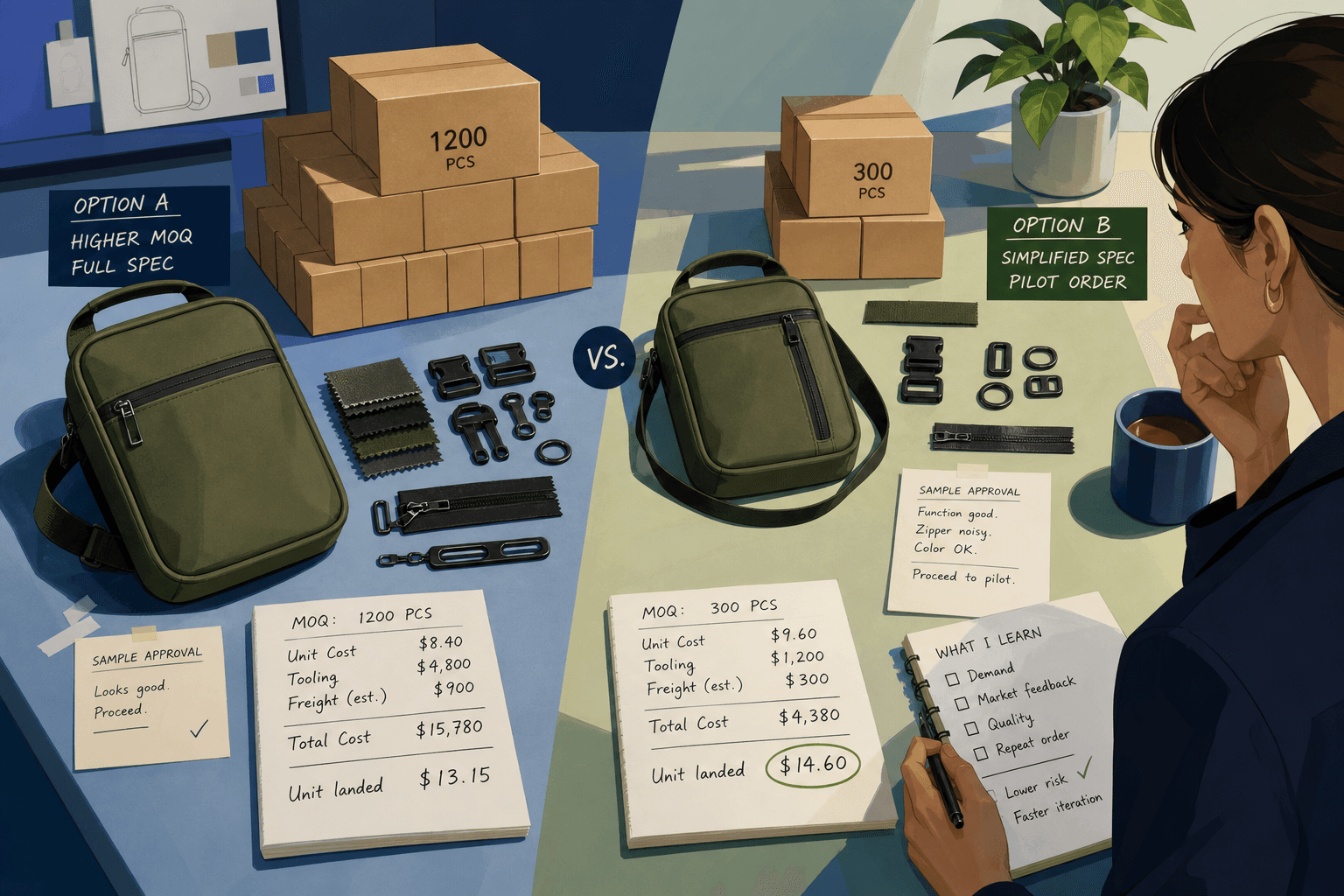
| Option | Specification fit | Landed cost clarity | MOQ flexibility | Quality risk | Internal workload | Lead time | Cash exposure |
|---|---|---|---|---|---|---|---|
| Better-fit supplier with higher MOQ | Strong | Usually clearer | Lower | Lower if controls are solid | Lower to moderate | More predictable | Higher inventory cash |
| Smaller run through simplified spec | Good if simplification is controlled | Must be normalized carefully | Higher | Moderate | Moderate to higher | Can improve or worsen | Lower opening inventory |
What changes the recommendation? Usually one tradeoff: whether reducing the first order preserves product reliability. If a lower opening quantity requires unstable packaging, too many manual workarounds, or a supplier that cannot provide the records you need, I would either accept the higher MOQ from the better-fit supplier or simplify the product further before placing any PO.
When paying more is the cheaper decision
There is a stubborn idea in sourcing that success means getting the unit price down. For a first order, success often means buying cleaner information.
If paying a separate setup fee lets you avoid six months of excess inventory, that can be sensible. If accepting one standard color lets you test whether the product itself sells, that is often sensible. If switching to in-stock materials lets you avoid inventing a new supply chain for a speculative SKU, that is usually worth serious consideration.
The opposite is also true. If the supplier can only make your pilot work by raising the unit price to a level that breaks your margin even if later orders scale, you’ve learned something useful. Either the spec is too customized for launch, the supplier is wrong for your stage, or the product should start as a simpler private-label version.
In some categories, format and labeling choices can also change what is negotiable. FDA says companies and individuals who market cosmetics are legally responsible for safety and labeling, and imported cosmetics remain subject to FDA review at entry (FDA cosmetics importers guidance). That doesn’t mean every cosmetic product should be imported in bulk or with deferred labeling. It does mean packaging ambition and product rules should be discussed separately, because sometimes they are driving your first-order structure more than the formula itself.
What your next supplier conversation should resolve
By the end of your next call or email thread, you want three answers.
First, which parts of the MOQ are caused by tooling, material minimums, packaging runs, testing, carton efficiency, or production scheduling.
Second, which of those can be paid separately, deferred to reorder, standardized to stock components, pooled across variants, or reduced by simplifying the spec.
Third, what changes if you choose the smaller run: unit price, lead time, inspection scope, documentation, and shipment structure.
If you need help comparing quotes this way across factories and packaging assumptions, AnyGoods can support that sourcing work through its services or contact page.
Your next move is not to ask for “the best MOQ.” Send one revised brief that removes nonessential complexity and asks the supplier to break the minimum into named cost drivers. Their answer will tell you whether to proceed, simplify, or change factories.
Supplier quote comparison
Put competing quotes on a common basis before choosing a factory or negotiating an existing SKU.
These fields organize a comparison; they do not calculate taxes or replace a current freight quote. Mark every estimate and its date.
See a completed example
- Common specification
- Use the same drawing revision, materials, approved reference, quantity and packaging requirements for every supplier.
- Unit price and setup costs
- Supplier A / B / C: unit price, currency, MOQ, tooling, sample fees, setup fees and what is excluded.
- Delivery basis and logistics
- Record the exact Incoterm, version and named place. Separately record freight, insurance, brokerage and destination handling assumptions.
- Landed-cost assumptions
- Itemize applicable verified duties, shipping and nonrecoverable fees. Divide order-level costs by the relevant sellable units. Separate recoverable taxes from expense assumptions.
- Quality and lead time
- Compare tests, inspection scope, acceptable variation, sample approval, production lead time and capacity evidence.
- Cash and risk
- Record deposits, balance timing, currency exposure, inspection remedies and cost of financing or storing extra units.
- Retail pricing context
- Record net selling price, discounts, payment fees, fulfillment, returns and acquisition-cost assumptions separately. Calculate contribution using a clearly defined denominator.
- Decision and open questions
- State which option you favor and why. List unresolved assumptions that could reverse the decision before you approve the order.
Make your own brief
Your entries stay in this tab. Download before leaving; they are not saved or sent to AnyGoods.
Sources & further reading
- CBP: What value should be on the commercial invoice submitted to U.S. Customs and Border Protection?help.cbp.gov
- CBP: Commercial invoice requirements when clearing or filing entry documentshelp.cbp.gov
- CPSC: Children’s Product Certificatecpsc.gov
- CPSC: Third Party Testing Guidancecpsc.gov
- LII: 16 CFR § 1110.13 Certificate availabilitylaw.cornell.edu
- CPSC: Toy Safetycpsc.gov
- Trade.gov: Know Your Incotermstrade.gov
- ISO 9001:2026 - Quality management systems — Requirementsiso.org
- NIST: How to Write an RFP + Vet Suppliers for Your Small Businessnist.gov
- FDA: Cosmetics Importersfda.gov
Published by AnyGoods Editorial. Examples are illustrative unless a source is identified. Updated .