
A lot of product pricing mistakes start before the first order is placed.
You get a supplier quote, add a healthy-looking markup, decide the retail price seems plausible, and move on to samples or production. Then the product launches and the tidy margin on paper gets chewed up by fulfillment, shipping subsidy, discounts, returns, payment fees, and whatever else was left sitting just outside the spreadsheet frame.
That is the real use of DTC product pricing contribution margin. It is not a finance term to revisit after launch. It is a sourcing decision tool for the week you have to approve a quote, accept an MOQ, or walk away from a product that only works in optimistic math.
The recommendation is straightforward: price the SKU from contribution margin, not from factory price or markup alone. Start with what it costs to get one sellable unit into stock, then subtract the selling costs that rise when one more unit sells. Use gross margin as a check. Do not use it as the main reason to commit cash.
Start with the cost boundary, not the markup
If the cost boundary is sloppy, the pricing decision will be sloppy too.
Factory price is the supplier's product price at the agreed term. Useful, but incomplete.
Landed cost is what it takes to get sellable inventory into your warehouse or 3PL. Depending on the quote and shipment, that can include freight, insurance, duties, brokerage, receiving, and local delivery. Shipping terms matter because Incoterms assign transport and customs responsibilities between buyer and seller, which changes both cost ownership and internal workload (U.S. Department of Commerce on Incoterms). A quote can look cheaper simply because more work and cost have been pushed onto you.
Gross margin usually means selling price minus product cost, expressed against selling price. Fine as far as it goes. The problem is that it often stops too early.
Contribution margin is what remains after the variable costs tied to selling the unit. For a DTC SKU, that often means landed cost plus payment fees, fulfillment, outbound shipping subsidy, marketplace commissions if relevant, discounts, returns, and any selling cost you can reasonably attach to that SKU or channel.
Then there is cash tied up in inventory, which deserves its own line of thought. A product can show acceptable contribution per unit and still be a bad order if the MOQ, tooling, lead time, and payment terms soak up too much cash before you have learned whether the thing really moves.
One other boundary matters at sourcing stage: customs value is not your retail price. U.S. Customs and Border Protection says the invoice value should reflect the price paid for the imported goods, not the eventual U.S. resale price, and certain additions such as packing, assists, and royalties may need to be included where applicable (CBP guidance on commercial invoice value). That does not tell you whether the SKU is profitable. It does tell you why packaging, tooling arrangements, and component supply can affect landed cost and cash planning.
Read the video transcript
A product can look profitable on paper, then get squeezed by shipping, fulfillment, discounts, returns, and fees after launch because the first pricing decision used too narrow a cost view. The article’s point is simple: decide from contribution margin, not factory price alone, because it shows what one more sale actually leaves after variable selling costs. Start with landed cost for a sellable unit, then subtract payment fees, fulfillment, shipping support, discounts, returns, and any channel-specific selling cost you can reasonably assign. In the kitchen accessory example, Supplier B’s lower piece price lost once freight and import costs raised landed cost, leaving one dollar less contribution on a forty-dollar order. Before pushing for a small discount, ask about packed dimensions, units per carton, protective inserts, shipping terms, and MOQ breaks, since those details can move cost and damage risk. A slightly better per-unit result may still be the wrong first order if a bigger MOQ ties up cash and slows learning, so compare months of cover too.
The pre-production worksheet that actually answers the buying question
Before you approve a supplier, run the SKU through one simple line of math:
Selling price
minus landed cost per sellable unit
minus payment processing
minus marketplace commission, if any
minus pick-pack and outbound fulfillment
minus shipping subsidy you absorb
minus average discount or promo leakage
minus expected returns and replacement allowance
minus any SKU-specific affiliate or acquisition cost you can reasonably assign
= contribution per unit
That is the number you are trying to protect before production.
This is not an argument for perfect accounting at quote stage. It is a way to stop a bad sourcing choice from hiding behind a decent markup.
If you sell in more than one channel, run the same SKU through more than one version of the model. A product may work on your own site and fail on a marketplace once fees and handling are included. Or the reverse. If you need a cleaner starting point for the quote itself, how to compare manufacturing quotes beyond the unit price is worth reading before you start debating pennies that sit on different cost boundaries.

Worked example: the cheaper factory quote loses
Here is a hypothetical example.
Say you sell a kitchen accessory at $40 retail on your own site.
Supplier A quotes:
- Ex-factory cost: $8.00 per unit
- Estimated freight, duty, insurance, and receiving: $3.00 per unit
- Landed cost: $11.00 per unit
Supplier B quotes:
- Ex-factory cost: $7.20 per unit
- Estimated freight, duty, insurance, and receiving: $4.80 per unit
- Landed cost: $12.00 per unit
On piece price alone, Supplier B looks better. That is the sort of number people circle in red and regret later.
Now add hypothetical selling costs for owned-channel orders:
- Payment processing: $1.20
- Pick-pack fulfillment: $4.50
- Average shipping subsidy: $3.80
- Average discount allocation: $2.00
- Expected returns cost per unit sold: $1.50
Total variable selling costs excluding landed cost: $13.00
The contribution math is simple.
Supplier A
$40.00 selling price
− $11.00 landed cost
− $13.00 variable selling costs
= $16.00 contribution per unit
Supplier B
$40.00 selling price
− $12.00 landed cost
− $13.00 variable selling costs
= $15.00 contribution per unit
The point is not that one dollar settles the choice. The point is that the supposedly cheaper quote stopped being cheaper as soon as you used the right cost boundary.
Now carry that example one step further, because this is where the next supplier call usually gets wasted.
Do not ask, "Can you do better price?" first. Ask the questions that can change landed cost or damage risk.
For Supplier B, a sensible message would be:
"Please confirm packed unit dimensions, master carton dimensions, units per carton, and carton gross weight for the quoted packaging. Does the quote include the same insert and protective packaging shown in the sample? Please also confirm the quoted Incoterm and whether there are MOQ breaks by packaging version or component."
Each answer changes something real. If the insert is bulkier than expected, freight per sellable unit may rise. If carton density is poor, the ex-factory savings may disappear in transit cost. If a lower MOQ is possible only with a packaging change, you have another lever to compare. This is exactly the sort of cost-driver work covered in how to reduce product manufacturing costs without cutting quality, and it is usually more productive than making the supplier perform a ceremonial 3% discount.
The tradeoff that changes the recommendation most
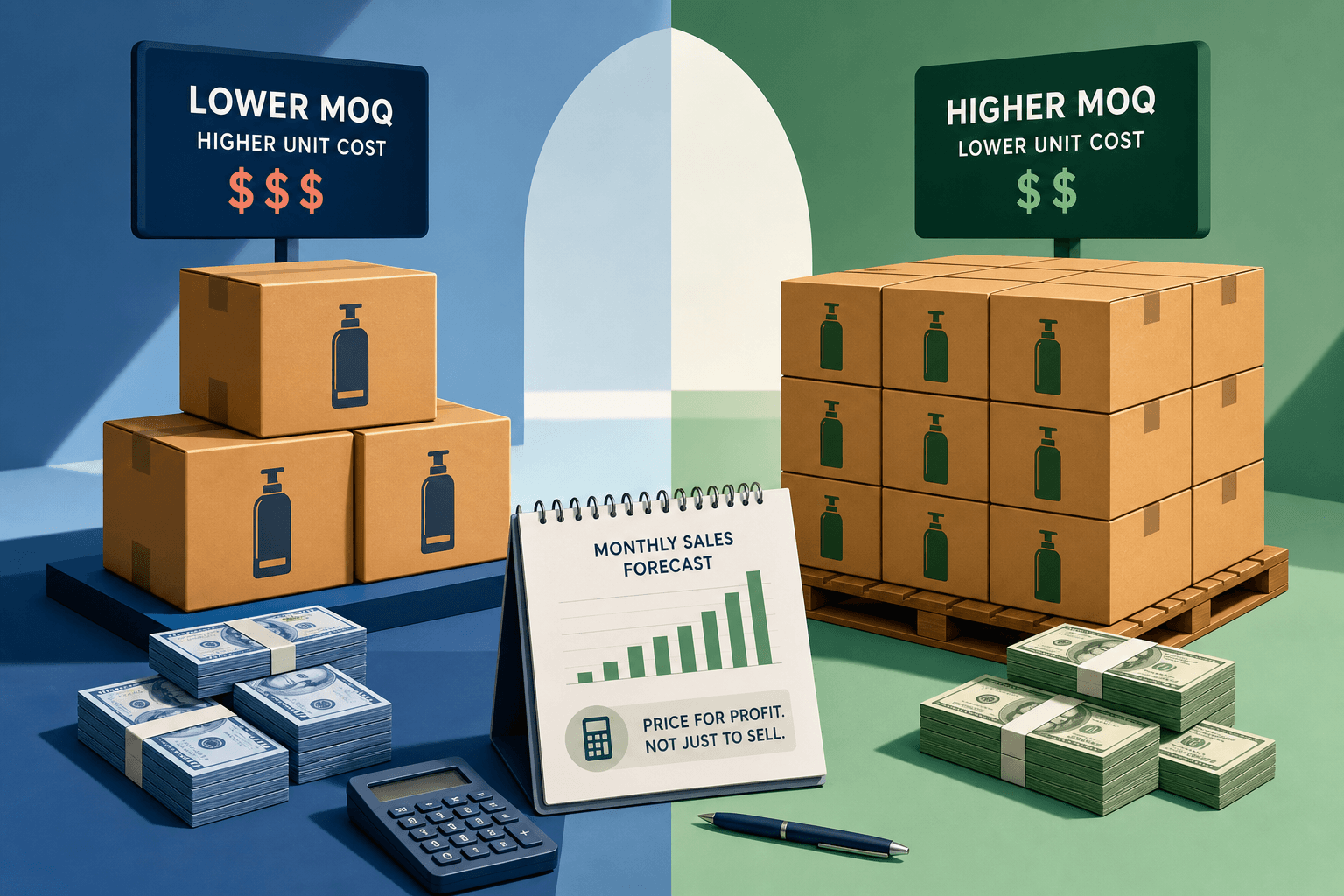
The decision usually turns on one tradeoff: lower ex-factory cost versus higher cash exposure and operating risk.
Founders often talk about this as if it were a margin question. It is usually a stock-and-cash question wearing a margin hat.
Consider a second hypothetical example.
Say you sell a personal-care accessory at $24 retail.
Option A:
- Ex-factory unit cost: $5.50
- MOQ: 2,000 units
- Factory outlay before freight or tooling: $11,000
Option B:
- Ex-factory unit cost: $4.90
- MOQ: 6,000 units
- Factory outlay before freight or tooling: $29,400
Assume, for illustration, that the freight and import differences are small enough that the final contribution math comes out like this:
- Option A contribution per unit: $7.20
- Option B contribution per unit: $7.60
So B wins by $0.40 per unit.
That sounds nice until you add demand reality. If your base forecast is 500 units per month, then:
- Option A covers about 4 months of sales: 2,000 ÷ 500 = 4
- Option B covers about 12 months of sales: 6,000 ÷ 500 = 12
For a first run, that usually changes the recommendation. Option B ties up far more cash. It gives you slower feedback. It increases markdown risk if the product underperforms or the packaging needs to change after launch. The slightly better unit contribution may not be worth a year of inventory sitting around trying to teach you expensive lessons.
This is why minimum order quantities: negotiate a first order you can afford to learn from is not really an MOQ article so much as a cash-risk article. Lower piece price is not automatically the better buying decision.
I would choose differently if demand visibility were already strong, reorder lead time were short enough to avoid stockouts, or a larger buy meaningfully improved supply resilience for a product with proven sell-through. Absent that, first orders should usually preserve learning speed, not optimize for the prettiest unit cost on a quote sheet.
What information the buyer needs before deciding
Three inputs matter before you approve the production run.
First, confirm the true landed-cost build. That means the shipping term, packing assumptions, carton details, receiving assumptions, and any tooling or assists that affect cost or declared value. CBP notes that packing and certain assists may matter to declared value where applicable (CBP commercial invoice guidance). The practical point is not customs theory. It is that these details can move your cost per sellable unit.
Second, decide which selling costs genuinely belong in the contribution model for this SKU. Include the costs that reliably rise when one more unit sells. Keep fully fixed overhead out of it. If the SKU is mainly sold on your own site, payment processing, fulfillment, outbound shipping support, discounts, and returns probably belong in the model. If the SKU is mainly marketplace-driven, add marketplace commissions and channel-specific handling. If paid acquisition is tightly tied to the SKU or launch campaign, model it as a range rather than pretending certainty you do not have.
Third, check whether the product carries category-specific compliance work that changes launch cost or timing. For some general-use consumer products subject to safety rules, a General Certificate of Conformity is required based on testing or a reasonable testing program. For children's products subject to applicable rules, third-party testing and a Children's Product Certificate are required (CPSC general-use products guidance; CPSC children's product certificate guidance). Those same CPSC pages also note the electronic filing requirement that began on July 8, 2026 for most regulated consumer products. That does not mean every ecommerce product needs the same testing. It means you should find out before your margin model quietly assumes no compliance burden.
What to inspect in samples and quote revisions
This is the point where contribution margin stops being a spreadsheet topic and becomes a physical-product topic again.
If packaging changes are on the table, inspect three things in the next sample or packing proof: protection level, packed dimensions, and units per carton. The finding changes the decision in different ways.
If the product arrives well protected but the insert adds too much bulk, your freight cost per sellable unit may rise enough to erase a lower ex-factory price. If packed dimensions are tighter without increasing damage risk, contribution improves without touching retail price. If units per carton increase but handling gets awkward or damage risk rises, you need to decide whether lower freight is worth the operational tradeoff.
For the kitchen accessory example above, I would ask the supplier for two packing versions and compare them on the same table: current insert versus simplified insert, with dimensions, weights, units per carton, and sample drop or transit protection notes. Not because one always wins, but because packaging is often where a quote becomes more or less viable without changing the product itself.
If you are still deciding whether to manage all of that in-house or bring in outside support, sourcing agent vs buying direct: which route fits your brand? is a fair comparison of the workload and risk tradeoff.
Your internal pricing model is not your public price claim
One separate caution: internal contribution math and consumer-facing price presentation are not the same thing.
The FTC says covered businesses must disclose total price as required by its rule on unfair or deceptive fees, and its small-business advertising guidance makes clear that price claims, sale claims, and "free" claims should not mislead consumers (FTC fees rule FAQ; FTC advertising FAQs for small business). That does not tell you what your contribution target should be. It does tell you not to patch over weak economics with fuzzy advertised pricing.
Use ranges where you do not know enough yet
A fair objection is that some inputs are unknown before launch. Return rates are estimates. Channel mix may change. Acquisition cost may wobble all over the place.
True. That is not a reason to retreat to markup.
Use ranges where you lack certainty. Build a low, base, and high case for returns. Model owned-channel and marketplace versions separately if both are plausible. If you are unsure whether you will subsidize shipping, run both scenarios. The right answer at sourcing stage is not perfect precision. It is knowing whether the SKU still makes sense when your assumptions become slightly less flattering.
The next move before you commit cash
Build one normalized quote sheet for the SKU in front of you now. For each supplier option, list the same fields: spec match, ex-factory price, MOQ, tooling, packed dimensions, units per carton, shipping term, estimated landed cost, contribution by channel, total first-order cash, and months of cover at your base forecast.
Then use your next supplier conversation to resolve the two or three inputs that could actually change the choice. In most cases, that is packaging density, MOQ by variant, and shipping term. If you need help normalizing quotes across landed cost, MOQ, packaging, and production risk, AnyGoods can support the sourcing process at /#services or you can start the conversation at /#contact.
Supplier quote comparison
Put competing quotes on a common basis before choosing a factory or negotiating an existing SKU.
These fields organize a comparison; they do not calculate taxes or replace a current freight quote. Mark every estimate and its date.
See a completed example
- Common specification
- Use the same drawing revision, materials, approved reference, quantity and packaging requirements for every supplier.
- Unit price and setup costs
- Supplier A / B / C: unit price, currency, MOQ, tooling, sample fees, setup fees and what is excluded.
- Delivery basis and logistics
- Record the exact Incoterm, version and named place. Separately record freight, insurance, brokerage and destination handling assumptions.
- Landed-cost assumptions
- Itemize applicable verified duties, shipping and nonrecoverable fees. Divide order-level costs by the relevant sellable units. Separate recoverable taxes from expense assumptions.
- Quality and lead time
- Compare tests, inspection scope, acceptable variation, sample approval, production lead time and capacity evidence.
- Cash and risk
- Record deposits, balance timing, currency exposure, inspection remedies and cost of financing or storing extra units.
- Retail pricing context
- Record net selling price, discounts, payment fees, fulfillment, returns and acquisition-cost assumptions separately. Calculate contribution using a clearly defined denominator.
- Decision and open questions
- State which option you favor and why. List unresolved assumptions that could reverse the decision before you approve the order.
Make your own brief
Your entries stay in this tab. Download before leaving; they are not saved or sent to AnyGoods.
Sources & further reading
- What value should be on the commercial invoice submitted to U.S. Customs and Border Protection?help.cbp.gov
- Know Your Incotermstrade.gov
- The Rule on Unfair or Deceptive Fees: Frequently Asked Questionsftc.gov
- Advertising FAQ's: A Guide for Small Businessftc.gov
- General Use Products: Certification and Testingcpsc.gov
- Children's Product Certificatecpsc.gov
Published by AnyGoods Editorial. Examples are illustrative unless a source is identified. Updated .