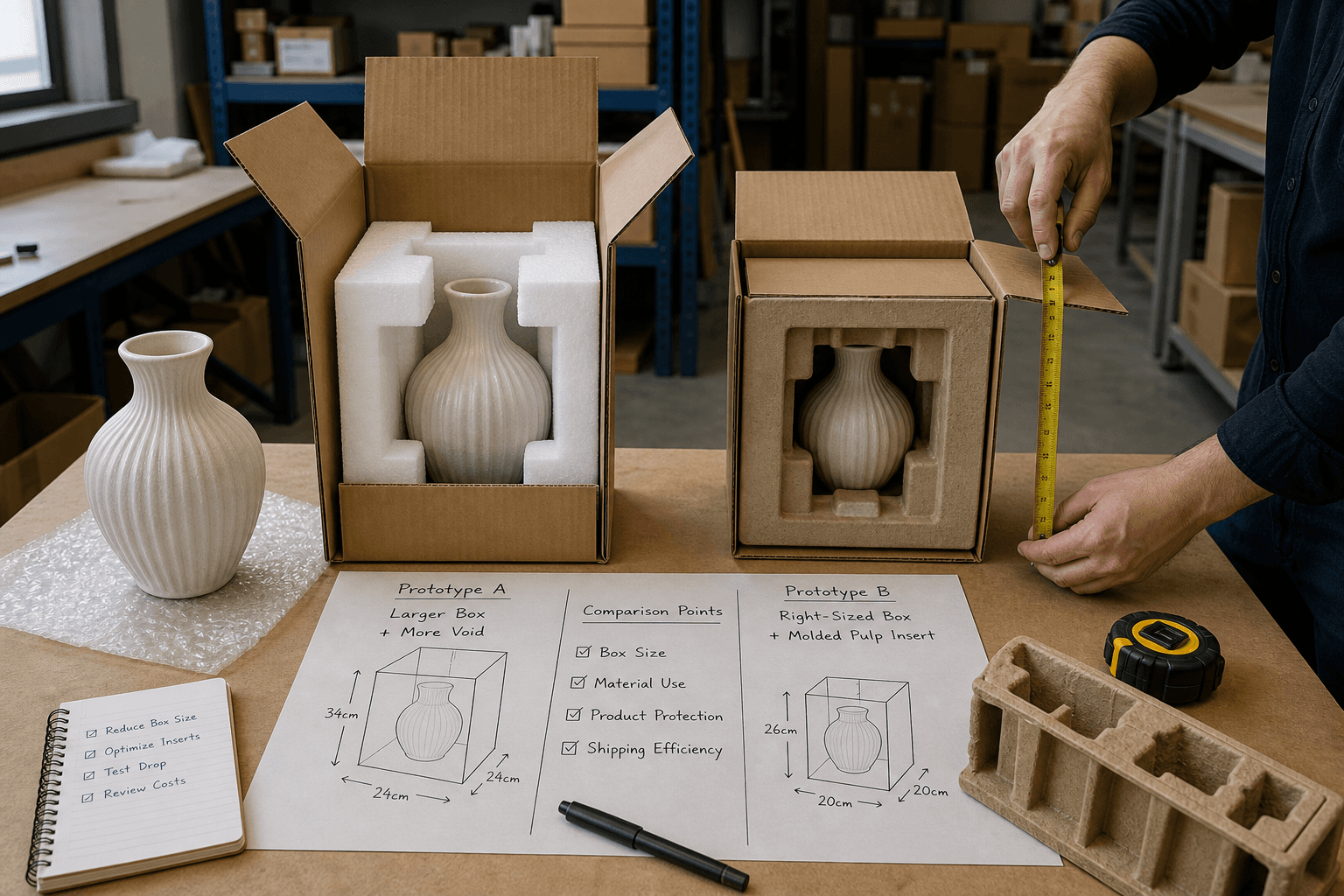
You have three quotes, two samples, and one supplier asking for a deposit by Friday. The cheapest unit price is trying very hard to win the argument on its own.
Don't let it.
If you're deciding this week, the real job is not to pick the lowest number in a spreadsheet. It's to choose the lowest-risk way to get sellable inventory into your market without tying up more cash than the business can handle.
That's the point of view here: a manufacturing quote is not just a price. It's a bundle of cost boundary, scope, risk transfer, and cash timing. If you don't normalize those parts first, you're not comparing quotes. You're comparing different jobs that happen to share a SKU name.
For most ecommerce and DTC brands, the decision should be made on the same seven criteria across every supplier: specification fit, landed-cost boundary, MOQ, quality risk, internal workload, lead time, and cash exposure.
If your brief is still loose or your supplier list isn't qualified yet, how to find a manufacturer and compare the right factories and how to source your first product cover that groundwork. If the quotes are already in your inbox, start with the boundary.
Put every quote on the same commercial boundary
Before you compare prices, make each supplier quote the same handoff point and the same included work. Otherwise one supplier is pricing a product, another is pricing a product plus packaging, and a third is pricing a problem for your team to solve later.
This matters most when suppliers quote under different Incoterms. Those terms define who handles delivery steps, costs, and some customs formalities, so an EXW quote and an FOB quote are not comparable until you adjust them to the same boundary (Trade.gov's Incoterms overview).
Ask each supplier to restate the quote with these items separated:
- unit price
- Incoterm and named place
- one-time tooling or setup charges
- packaging included
- labeling included
- sample costs and whether refundable
- production lead time from deposit and from sample approval
- payment terms and timing
That request is not fussy. It's basic purchasing hygiene. If a supplier can't explain what is and isn't included before the PO, don't expect clarity once money is in motion.
Worked example 1: the low unit price that costs more
Say you sell a private-label home accessory online. You're comparing two hypothetical quotes for the same intended SKU.
Quote A
- Unit price: $2.70
- Incoterm: EXW
- MOQ: 5,000 units
- Tooling: $1,200 upfront
- Packaging: plain bulk pack only
- Barcode label and retail insert: not included
- Payment: 50% deposit / 50% before shipment
Quote B
- Unit price: $2.92
- Incoterm: FOB
- MOQ: 3,000 units
- Tooling: included
- Packaging: retail carton, insert, and barcode label included
- Payment: 30% deposit / 70% before shipment
To compare them, normalize Quote A to the same commercial scope as Quote B. Using illustrative assumptions only:
- pickup, export handling, and admin to reach an FOB-equivalent boundary: $0.08/unit
- retail packaging and labeling add-on: $0.14/unit
- tooling spread across the first order: $1,200 / 5,000 = $0.24/unit
Quote A's first-order effective cost becomes:
$2.70 + $0.08 + $0.14 + $0.24 = $3.16/unit
Quote B stays $2.92/unit if those items are actually included at the quoted boundary.
So the apparent savings disappear. More to the point, Quote A also asks you to buy more units and pay a larger deposit against a less complete scope.
The next supplier questions here are simple and useful:
- "Please confirm the exact Incoterm and named handoff point."
- "Please list all packaging and labeling included at this price."
- "Please separate one-time tooling from recurring cost."
- "If we reorder without changes, which charges disappear?"
At this stage, don't ask for a grand vision statement. Ask what you're buying.
Read the video transcript
You've got quotes, samples, and a deposit deadline, and the cheapest line item can drown out the real question: how to get sellable stock safely without straining cash. A quote isn't just price; it also hides scope, handoff point, timing, and risk. If those differ, you're not comparing suppliers so much as different jobs. In the article's home-accessory example, Quote A looked cheaper at $2.70, but once packaging, labeling, export handling, and tooling were added, first-order cost rose above Quote B. That matters because a lower quote can reflect thinner materials, rougher finish, or simpler pack-out. Hidden assumptions create returns, extra work, and late surprises. Ask each supplier to restate the same handoff point, included packaging and labeling, one-time charges, payment timing, and what proof exists for documentation or quality expectations. You don't need the lowest sticker price; you need the quote that fits today's business. A short decision note usually reveals whether savings are real or expensive later.
Make sure they're quoting the same product
A lot of quote comparisons go wrong before freight, duty, or payment terms ever enter the picture. The suppliers are not all pricing the same specification.
The differences are usually annoyingly ordinary: material grade, thickness, hardware finish, print method, carton strength, insert count, or tolerance assumptions. One supplier looks cheaper because they priced a lighter or less controlled version of the product.
So compare against the same spec revision, and ask each supplier to state any assumptions in writing. If your brief is still unsettled, say so. Vague requirements aren't fatal; hidden assumptions are.
What to inspect in the samples depends on the product, but the principle is the same: inspect the features most likely to change cost or create returns. For a home accessory, that might be dimensions, finish consistency, moving parts, closure fit, and how the retail pack holds up to a basic drop or compression check appropriate to the item. If a barcode or retail label is part of the job, scan it and check placement before you approve anything.
Carry the first example forward. If Quote A's sample shows thinner walls, rougher finish, or a simpler pack-out than Quote B, you don't yet have two prices for the same product. You have one price for your product and another for a nearby relative.
A useful supplier question here is: "Please mark any cost difference between the sample you sent and the exact production spec we're asking you to quote." That forces the supplier to state whether the sample proves capability or merely starts a conversation.

Compliance work belongs in the quote, even when it isn't priced cleanly
A quote can look complete and still leave the most awkward work on your side of the table.
For U.S. consumer products, manufacturers and importers can have direct certification and testing responsibilities where applicable, and importers remain responsible for the safety of products they import (CPSC on general-use products; CPSC online seller FAQs). For covered consumer non-food products in the EU, importers and responsible operators also have obligations around compliance, traceability, and market placement (EUR-Lex GPSR summary).
What those sources support is responsibility, not a universal test list. The exact requirements still depend on the product, materials, claims, and market. That's the limit that matters here. You shouldn't pretend a supplier's generic "compliant for US/EU" note settles the issue, but you also shouldn't force every quote into the same compliance script if the product categories differ.
So compare quotes by asking what evidence exists now and what still needs verification.
Useful questions:
- "Which market is this documentation intended to support: US, EU, or both?"
- "What test reports, material declarations, or certificates do you already have for this exact product or bill of materials?"
- "Are those documents specific to this item, this material, or just a similar product?"
- "What labeling and traceability files will be ready before shipment?"
Now go back to the same home-accessory example. If Quote B includes retail labeling and can provide product-specific material documentation for review, while Quote A answers with general assurances and no itemized evidence, that should change your decision. Not because paperwork is thrilling. Because unresolved compliance work tends to surface late, when stock is built and the money is already gone.
Don't guess duties from the product name
Founders often try to settle a quote comparison by dropping in a duty percentage from memory. That usually feels efficient right up until it isn't.
U.S. tariff treatment depends on classification, and the official HTS help notes that users should not rely on search alone; the legal text, prior rulings, or expert help may be needed (USITC HTS Help). USITC also notes that antidumping and countervailing duties are separate from ordinary tariff lines, which is another reason a quick spreadsheet estimate can be incomplete (USITC tariff classification FAQs). CBP guidance puts responsibility for classification, value, and duty declarations on the importer, who must exercise reasonable care (CBP importer guidance).
That doesn't mean you need a perfect landed-cost model before you can choose between quotes. It does mean all quotes should be compared using the same classification assumptions, or flagged as unresolved.
Ask suppliers:
- "Which tariff classification are you assuming for this estimate?"
- "What material or construction details would our broker need to confirm it?"
- "Is there any component that could change classification?"
If one supplier has clearly thought through the product details and another is waving vaguely at customs, treat that as a commercial difference, because it is one.
Quality risk isn't a footnote
Cheap quotes often leave quality acceptance fuzzy. That's not accidental. Undefined standards are a convenient place to hide future arguments.
There is no automatic default that saves you here. ISO's overview of sampling procedures describes their use as part of bilateral agreement, and ASTM drafting guidance notes that quality assurance requirements apply when specified in the purchase order or contract (ISO 2859-4 overview; ASTM standards drafting guidance). Those sources do not prove one sampling level is right for every product. They do support a simpler point: if you want an acceptance standard, write it into the deal.
So when two quotes look close, inspect what happens when production is not quite right.
Ask:
- "Which approved sample will production be matched against?"
- "What defects would stop shipment?"
- "Who approves packaging before mass production starts?"
- "If inspection finds a major issue, what is the agreed remedy: rework, replacement, credit, or something less comforting?"
Again, take Quote A and Quote B. If Quote B agrees that the approved retail-packed sample is the production reference and Quote A treats sampling as a vague prelude to improvisation, Quote B is carrying more of the execution risk. That can justify a higher quoted price.
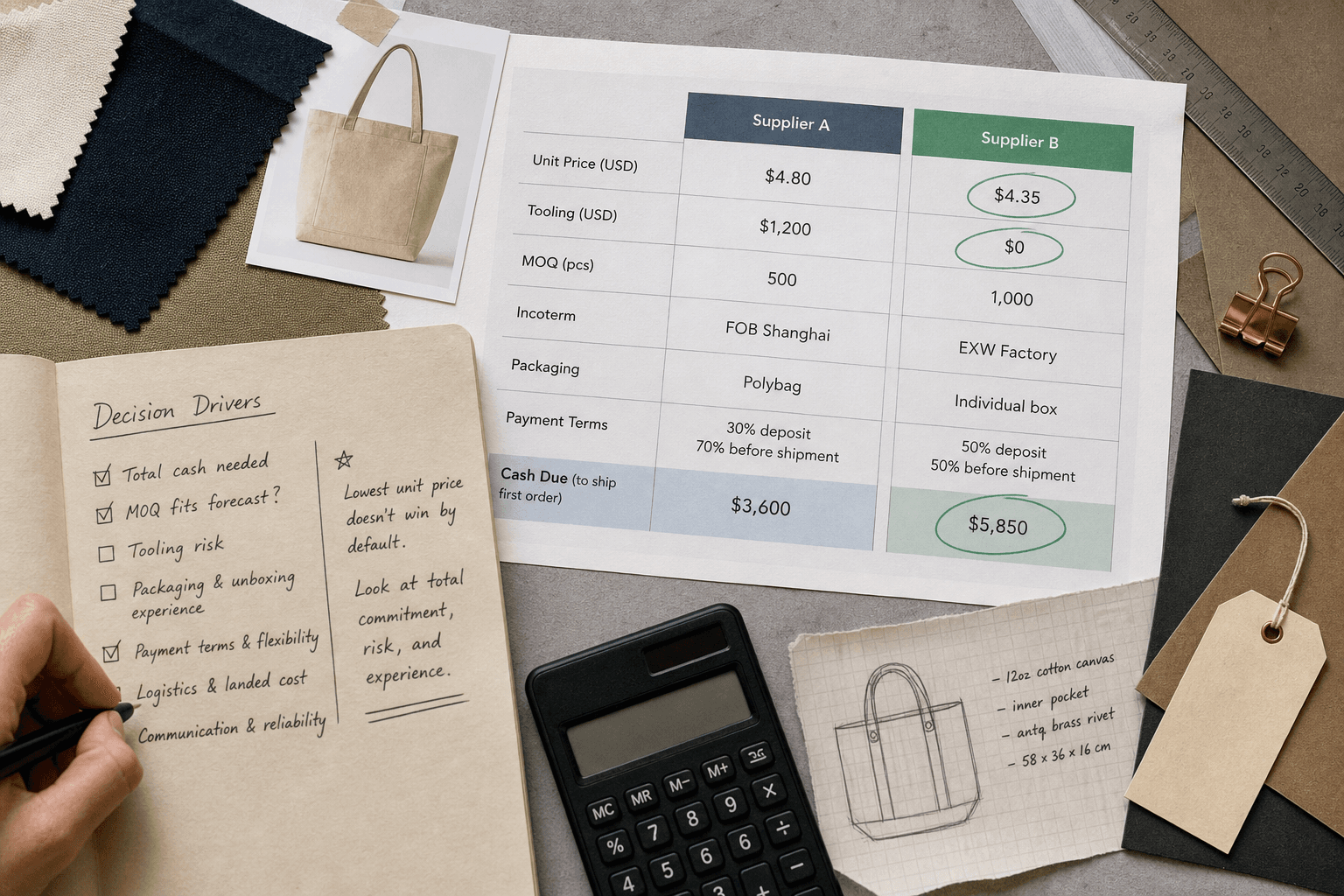
The tradeoff that usually changes the recommendation: cash exposure
For early production runs, cash exposure often matters more than the last few cents on unit cost.
Factory price affects gross margin. Payment terms, MOQ, and lead time affect whether you can afford to get through production and wait for sell-through. That's a different calculation.
Gross margin is selling price minus cost of goods sold. Contribution margin goes further and accounts for variable selling costs such as fulfillment or marketplace fees. Cash tied up in inventory is separate again: deposits, tooling, production payments, freight, and stock that hasn't sold yet. People blur these together all the time. Their bank account usually notices the difference first.
Worked example 2: similar product, very different cash risk
Imagine a non-electrical personal-care accessory sold in the U.S. and EU. Two hypothetical quotes come in.
Quote C
- Unit price: $1.85
- MOQ: 10,000
- Incoterm: FOB
- Payment: 100% before shipment
- Supplier says product is "US/EU compliant"
- No test scope defined
- No written acceptance criteria
Quote D
- Unit price: $1.97
- MOQ: 4,000
- Incoterm: FOB
- Payment: 30% deposit / 70% before shipment
- Supplier can provide materials list, labeling files, and prior market documentation for review
- Inspection criteria can be written into the PO
Illustrative cash comparison before shipment:
- Quote C goods value: 10,000 × $1.85 = $18,500 due before shipment
- Quote D goods value: 4,000 × $1.97 = $7,880 total
- Quote D initial deposit: 30% × $7,880 = $2,364 before production
This example doesn't prove Quote D always wins. It shows what changes the recommendation. If this is your first run, demand is still uncertain, and the compliance path isn't fully settled, Quote D may be the safer decision because it limits both inventory risk and ambiguity. If the product is already stable, documentation is verified, and repeat demand is predictable, Quote C may deserve another look later.
That is the tradeoff to name in your own decision note. Not "Which quote is cheapest?" but "Which quote fits the business we actually have right now?"
Write the decision note before you send the PO
You do not need a heroic spreadsheet with seventeen tabs and a personality disorder. You need a one-page note that makes the tradeoff visible.
For each supplier, record:
- what spec revision they priced
- quote boundary and Incoterm
- what is included beyond the product itself
- what still needs compliance verification
- what you found in the sample
- cash due before production and before shipment
- the main failure mode you would be betting against
Then write one sentence that justifies the choice.
For example: "Choose Supplier B for first production because the quote covers the required packaging scope at the right handoff point, MOQ is manageable, sample fit is acceptable, and the extra unit cost is lower than the setup and cash risk in Supplier A. Revisit Supplier A only after demand is proven and tooling can be spread across repeat orders."
If you can't write that sentence, you probably don't have enough clarity to place the order.
If you're comparing quotes that look close on unit price but drift apart on tooling, packaging, documentation, or payment structure, that's often the point where outside support is worth the fee. AnyGoods can help pressure-test supplier quotes on a like-for-like basis, review samples, and coordinate the production details that sit outside the unit price. See the sourcing services or send an inquiry.
What the next supplier conversation should resolve
Before you approve a sample or pay for tooling, resolve three things.
First, the commercial boundary: exact Incoterm, named handoff point, packaging, labeling, tooling, and payment milestones.
Second, the product boundary: spec revision, materials, finish, approved sample reference, and defect criteria.
Third, the evidence boundary: what documentation exists now, what still requires verification, and who is responsible for it before shipment.
If one supplier can answer those cleanly and another can't, you already have a decision trying to make itself. Take the call today and get the revised quote in writing.
Supplier quote comparison
Put competing quotes on a common basis before choosing a factory or negotiating an existing SKU.
These fields organize a comparison; they do not calculate taxes or replace a current freight quote. Mark every estimate and its date.
See a completed example
- Common specification
- Use the same drawing revision, materials, approved reference, quantity and packaging requirements for every supplier.
- Unit price and setup costs
- Supplier A / B / C: unit price, currency, MOQ, tooling, sample fees, setup fees and what is excluded.
- Delivery basis and logistics
- Record the exact Incoterm, version and named place. Separately record freight, insurance, brokerage and destination handling assumptions.
- Landed-cost assumptions
- Itemize applicable verified duties, shipping and nonrecoverable fees. Divide order-level costs by the relevant sellable units. Separate recoverable taxes from expense assumptions.
- Quality and lead time
- Compare tests, inspection scope, acceptable variation, sample approval, production lead time and capacity evidence.
- Cash and risk
- Record deposits, balance timing, currency exposure, inspection remedies and cost of financing or storing extra units.
- Retail pricing context
- Record net selling price, discounts, payment fees, fulfillment, returns and acquisition-cost assumptions separately. Calculate contribution using a clearly defined denominator.
- Decision and open questions
- State which option you favor and why. List unresolved assumptions that could reverse the decision before you approve the order.
Make your own brief
Your entries stay in this tab. Download before leaving; they are not saved or sent to AnyGoods.
Sources & further reading
- Trade.gov: Know Your Incotermstrade.gov
- CBP: What Every Member of the Trade Community Should Knowcbp.gov
- USITC: HTS Helpusitc.gov
- USITC: FAQs about Tariff Classificationusitc.gov
- CPSC: General Use Products Certification and Testingcpsc.gov
- CPSC: Online Sellers Safety Guide FAQscpsc.gov
- EUR-Lex: General Product Safety Regulation summaryeur-lex.europa.eu
- ISO 2859-4 overviewiso.org
- ASTM: Form and Style for ASTM Standardsastm.org
Published by AnyGoods Editorial. Examples are illustrative unless a source is identified. Updated .