You’re about to place a production run, margins are tighter than they were six months ago, and someone suggests the classic move: ask the factory for 10% off.
Sometimes that works on paper. Then the next batch arrives with a thinner insert, rougher finish, more unit-to-unit variation, or packaging that saves a few cents and creates a returns problem. The unit price drops. The business does not improve.
If you want to reduce product manufacturing costs without cutting quality, don’t start with the discount request. Start by figuring out which costs are buying real product performance and which costs are just habit, overbuild, or poor structure.
That is the practical decision here: keep what is quality-critical, change what is not, and test the change before you commit cash. That approach fits the evidence better than simple price pressure. NIST advises buyers to evaluate suppliers on total cost of ownership rather than price alone, and U.S. Customs and Border Protection makes clear that imported goods can carry duties, taxes, and other fees beyond the factory invoice amount (NIST on supplier selection and total cost, CBP on duties, taxes, and fees).
Ask what is driving the quote
Before you ask for a lower number, ask what created the current one.
For a typical consumer product, quoted cost usually comes from some mix of materials, labor or machine time, setup, yield loss, packaging, tooling amortization, order quantity, and shipping density. Founders often focus on the first line and ignore the rest. Convenient, but expensive.
A better supplier email sounds like this:
- What are the top three cost drivers in this quote?
- Of those, which are material, labor/process, packaging, yield loss, setup, or MOQ-related?
- Which specifications are critical to product performance, safety, certification, or compliance?
- Which proposed changes would lower cost without changing function?
Those questions do two useful things. First, they force the supplier to point to an actual lever instead of offering vague promises. Second, they tell you what to sample and inspect.
This matters because product requirements are your job to define, not the factory’s. ISO’s guidance for buyers is blunt on that point: ISO 9001 does not define the specifications for the products you purchase; the buyer has to make requirements clear through drawings, standards, and acceptance criteria (ISO guidance for buyers and suppliers). That does not prove any specific cost-down change is safe. It does support a useful and often neglected conclusion: many avoidable costs begin in the brief. Our guide to turning a product idea into a factory-ready brief shows how to define the requirements before asking manufacturers to quote.

Read the video transcript
When margins tighten, asking for ten percent off feels easy, but a cheaper batch can arrive rougher, thinner, or break more often, leaving the business worse off. The better move is asking what actually drives the quote, because some costs protect performance while others come from habit, overbuild, setup, or wasteful packaging. In the article's ceramic accessory example, the product stays unchanged while packaging is redesigned, since better carton density can trim pack materials and freight together. One option looked cheapest on paper, yet if it increased movement, breakage, or a sloppier arrival, those savings would come back as replacements and support time. Before approving any change, ask what must stay locked for function, safety, certification, or labeling, and whether a larger minimum order ties up too much cash. A good supplier conversation ends with two concrete options, clear evidence to approve them, and a landed-cost view, because lower unit price alone doesn't guarantee improvement.
What usually can change without hurting quality
For most ecommerce and DTC products, the safest cost-down work sits around the edges of the product, not in the parts that make it function.
That often includes cosmetic tolerances that are tighter than the market needs, low-volume variants that complicate purchasing and inventory, extra finishing steps that customers barely notice, inner packaging that is too cautious, and carton layouts that waste freight space.
What should not be changed casually is a shorter list, but a much more important one: safety-relevant materials, certified components, core performance specs, legal labeling elements, and anything already tied to test reports or certification files.
That’s not paranoia. The CPSC’s recall guidance notes that defects can come from design, composition, construction, finish, packaging, warnings, or instructions, not just from obvious factory errors (CPSC Recall Handbook). In other words, a cost-down change can create a quality problem even when the factory builds exactly what you asked for.
So the recommendation is simple enough to use this week: simplify what does not affect fit for purpose, and lock down what does. The hard part is being honest about which is which.
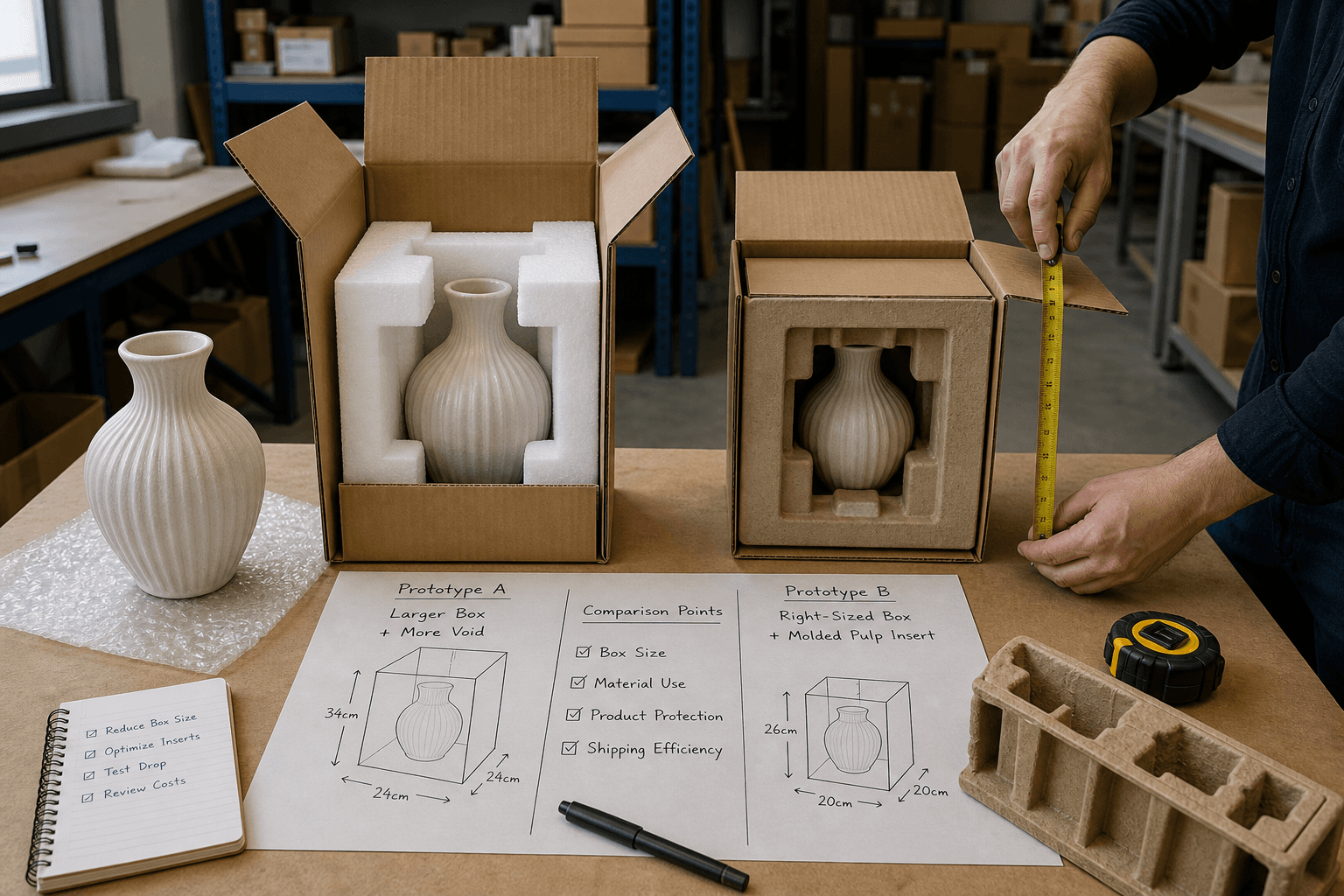
Example 1: Packaging first, because it can cut two costs at once
Say you sell a fragile ceramic bathroom accessory DTC. The product itself performs well. Reviews are solid. Damage complaints are not catastrophic, but they happen often enough to annoy your operations team and distort your reorder math.
Here is a hypothetical starting point:
- Ex-factory product cost: $6.40 per unit
- Inner packaging and insert: $1.10 per unit
- Units per master carton: 12
- Freight, duty, taxes, and import fees allocated per unit: $1.35
- Total landed cost: $8.85 per unit
The supplier says the molded insert is expensive and the carton is underfilled. That gives you a real cost project.
Keep the ceramic body, glaze, dimensions, and fit unchanged. Work on the packaging.
A usable supplier request would be:
“Please propose two packaging cost-down options that keep the product specification unchanged. For each option, show the pack materials, units per master carton, carton dimensions, gross weight, and any effect on packing speed. We will compare samples after transit testing.”
That is a better instruction than “make the packaging cheaper” because it tells the supplier what is fixed and what evidence will decide the issue.
There is good reason to start here. ISTA describes packaging optimization approaches aimed at reducing material until protection is still adequate, rather than preserving excess packaging forever because nobody wants to be the person who changed the box (ISTA on packaging optimization). That is guidance, not a legal requirement, and it does not guarantee every retailer or carrier will accept the result. But it does support a disciplined testing approach.
Imagine the supplier returns two hypothetical options:
| Option | Pack cost | Units/carton | Freight+import/unit | Landed cost/unit |
|---|---|---|---|---|
| Current | $1.10 | 12 | $1.35 | $8.85 |
| Option A | $0.92 | 16 | $1.18 | $8.50 |
| Option B | $0.78 | 18 | $1.05 | $8.23 |
Assumptions: the product cost stays at $6.40; only packaging and carton density change.
The arithmetic says Option B is cheapest. It does not say Option B is best.
Now inspect the sample with the right question: what changed, and what does that finding alter? Check product movement inside the pack, corner protection, compression resistance, drop damage, presentation on arrival, and whether the new configuration still suits your sales channel. If Option B produces more breakage or a sloppier unboxing experience, your freight saving is about to reappear as replacements, customer service time, and unpleasant reviews.
If Option A passes transit testing and holds product presentation, it is the better approval even if it is not the absolute cheapest line item. You have reduced landed cost without touching the product’s functional quality.
Carry the example one step further. Suppose your next question is MOQ. The supplier says Option A packaging only makes sense at 8,000 units because the insert tooling and carton print setup need more volume. That changes the decision again.
Here is the comparison in hypothetical terms:
- Current order: 4,000 units × $8.85 landed = $35,400 cash tied up
- Option A order: 8,000 units × $8.50 landed = $68,000 cash tied up
Per unit, Option A saves $0.35.
At 4,000 units, that saving would have been $1,400 if the same structure were available. But the actual offer requires an extra $32,600 in inventory cash compared with the smaller run.
That does not make Option A wrong. It means the decision is no longer just about product cost. It is now about inventory risk and cash timing. If demand is stable and the reorder cycle is long, the larger run may be sensible. If demand is still uncertain, a cheaper unit may be a more expensive business decision.
Example 2: The cheaper material that isn’t cheap
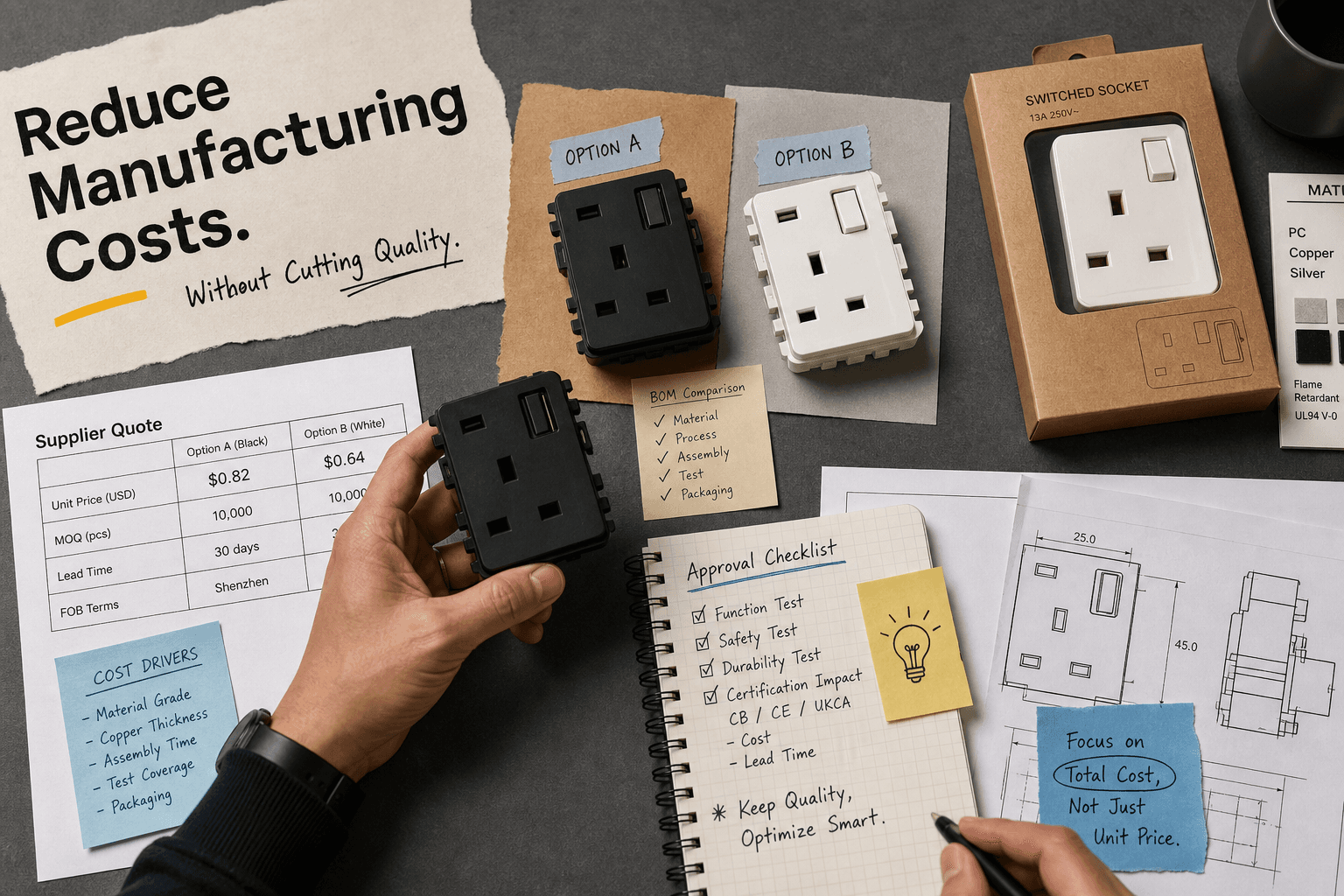
Now take a different product. Imagine a private-label plug-in electrical accessory. The supplier offers a lower quote if you switch resin and buy one internal component from another vendor.
This is where buyers get into trouble by treating all cost-down ideas as equivalent. They aren’t.
A better supplier note would say:
“Please identify whether the proposed resin or component change affects any certified construction, flammability rating, labeling, or safety-relevant performance. If yes, specify what sample approval, retesting, recertification review, or document updates would be required before production.”
That is not bureaucracy for its own sake. It is change control. FDA guidance for regulated manufacturing treats material, supplier, and process changes as controlled events that may require validation and review in relevant product categories (FDA process validation guidance). UL also explains that products bearing a UL Mark are subject to follow-up requirements so the manufactured product continues to match the evaluated construction where UL certification applies (UL follow-up services).
Those sources do not mean every consumer product change needs FDA-style validation or a fresh certification cycle. They do mean you should slow down when a cost-down touches a safety-critical or certified attribute.
Here is a hypothetical comparison:
- Current unit cost: $4.80
- Proposed unit cost: $4.45
- Nominal saving: $0.35 per unit
- Order quantity: 8,000 units
- Apparent saving: 8,000 × $0.35 = $2,800
Now add the non-unit costs that buyers like to forget until they become urgent:
- Additional testing or certification review: hypothetical $1,200
- New samples and engineering review time: internal cost varies
- Delay risk if approval takes three extra weeks: commercial effect depends on your launch window
- Reject risk if the alternate component behaves differently in assembly: unknown until sampled and inspected
At that point, the supplier needs to answer two direct questions.
First: “Show exactly which part number, material spec, or construction detail changes.”
Second: “Confirm whether current test reports, certification files, labels, or instructions remain valid after the change.”
If the changed component is truly non-critical, the cost-down may be worth approving after side-by-side sample review. If it affects a certified construction, flammability property, or safety claim, the paper saving can disappear quickly.
Landed cost is where weak savings plans fall apart
Buyers often chase a 3% factory reduction while ignoring the larger errors in freight structure, carton utilization, or import assumptions.
CBP is clear on two basics that matter here. Imported goods can incur duty, taxes, and other fees, and the commercial invoice value is tied to the price paid for the goods rather than the later resale price in the United States (CBP on import charges, CBP on commercial invoice value). CBP also distinguishes customs treatment of merchandise value from cost-insurance-freight concepts in specific contexts (CBP on CIF).
What those sources do not do is tell you your exact tariff classification, duty rate, or whether a country move will lower margin. Those depend on the product, origin, and current trade treatment. So if a sourcing change is meant to improve economics, confirm classification and import treatment before celebrating the spreadsheet.
Keep these terms separate when you compare quotes:
- Factory price: what the supplier charges to make the goods
- Landed cost: factory price plus freight, duties, taxes, and import-related fees
- Gross margin: selling price minus cost of goods sold
- Contribution margin: gross profit after variable selling and fulfillment costs
- Cash tied up in inventory: money absorbed by MOQ, lead time, and reorder timing
If a supplier offers a lower unit quote in exchange for a much larger MOQ, inspect what that changes. Does it lower landed cost enough to justify the extra inventory? Does it lengthen exposure if demand slips? Does it force you to carry slow variants longer than you should? Those are not finance-department abstractions. They decide whether the “saving” helps the business or just rearranges the pain.
When a supplier move makes sense
Changing supplier or country can reduce cost, but only if you compare the options against the same criteria: specification fit, landed cost, MOQ, quality risk, internal workload, lead time, and cash exposure.
Here is the fair version:
| Option | Where it fits | Main benefit | Main risk |
|---|---|---|---|
| Direct factory negotiation | You already have strong specs and know the factory well | Fast communication, fewer layers | Easy to push price without understanding downstream risk |
| In-house sourcing management | You have internal sourcing and quality capacity | More control over quote analysis and approvals | Heavy workload on sampling, QC, and logistics coordination |
| Outside sourcing support | You need help comparing factories, samples, and tradeoffs | Broader comparison and less internal coordination burden | Still depends on a clear brief and buyer decisions |
There is no universal cheapest country rule that safely solves this problem. A supplier in China, Vietnam, Thailand, Portugal, Mexico, or elsewhere may be the better fit depending on the product, tooling needs, material ecosystem, required compliance work, and order profile. Country stereotypes are quick. Production mistakes take longer to unwind.
If you need a second set of eyes while comparing factories, samples, and cost-down paths, AnyGoods can support that review through its sourcing services or help you start the discussion through contact.
What the next supplier conversation should settle
By the end of your next call or email thread, you want three things resolved.
First, identify the largest cost drivers in the quote. Not vague statements like “material is expensive.” Get the actual drivers: resin grade, polishing step, insert type, carton size, yield loss, tooling amortization, or order-volume assumptions.
Second, mark which requirements cannot change without re-approval. That includes anything tied to product function, safety, certification, legal labeling, or channel requirements.
Third, agree on the approval evidence for each proposed cost-down. That may mean revised quote breakdowns, side-by-side samples, dimensional checks, transit testing, pilot production, or a review of certification and import implications.
If the supplier cannot tell you what is driving cost, what is critical, and what proof would approve a change, you are not negotiating yet. You are guessing.
Send the email, ask for two concrete cost-down options, and make the supplier show which one changes cost without changing the part of the product your customer actually pays for.
Supplier quote comparison
Put competing quotes on a common basis before choosing a factory or negotiating an existing SKU.
These fields organize a comparison; they do not calculate taxes or replace a current freight quote. Mark every estimate and its date.
See a completed example
- Common specification
- Use the same drawing revision, materials, approved reference, quantity and packaging requirements for every supplier.
- Unit price and setup costs
- Supplier A / B / C: unit price, currency, MOQ, tooling, sample fees, setup fees and what is excluded.
- Delivery basis and logistics
- Record the exact Incoterm, version and named place. Separately record freight, insurance, brokerage and destination handling assumptions.
- Landed-cost assumptions
- Itemize applicable verified duties, shipping and nonrecoverable fees. Divide order-level costs by the relevant sellable units. Separate recoverable taxes from expense assumptions.
- Quality and lead time
- Compare tests, inspection scope, acceptable variation, sample approval, production lead time and capacity evidence.
- Cash and risk
- Record deposits, balance timing, currency exposure, inspection remedies and cost of financing or storing extra units.
- Retail pricing context
- Record net selling price, discounts, payment fees, fulfillment, returns and acquisition-cost assumptions separately. Calculate contribution using a clearly defined denominator.
- Decision and open questions
- State which option you favor and why. List unresolved assumptions that could reverse the decision before you approve the order.
Make your own brief
Your entries stay in this tab. Download before leaving; they are not saved or sent to AnyGoods.
Sources & further reading
- ISO guidance for buyers and suppliersiso.org
- 8 Ways to Improve Your Supplier Selection Process | NISTnist.gov
- Duty, Taxes and other Fees required to import goods into the United Stateshelp.cbp.gov
- What value should be on the commercial invoice submitted to U.S. Customs and Border Protection?help.cbp.gov
- Duty - Cost Insurance and Freight (CIF)help.cbp.gov
- Sustainability - International Safe Transit Associationista.org
- Recall Handbook (revised)cpsc.gov
- Guidance for Industryfda.gov
- Follow-Up Services: Ongoing Onsite Certification Inspections | UL Solutionsul.com
- Supply Chain Management | NISTnist.gov
Published by AnyGoods Editorial. Examples are illustrative unless a source is identified. Updated .