Your factory is not bad enough to replace. It is just late often enough to make every reorder feel like a bet.
That is the moment when operators start talking about a backup supplier. Fair enough. But a second factory does not reduce risk by existing in a spreadsheet. It reduces risk only if you qualify it well enough to take live production without creating new problems in cost, quality, compliance, and inventory.
That is the point of a workable second supplier strategy ecommerce teams can use. Add a second source when the downside of staying single-sourced is larger than the cost and complexity of qualifying another supplier. Wait when split volumes, duplicate work, or spec drift would do more damage than the original risk.
The real tradeoff is resilience versus fragmentation
This decision turns on one tradeoff: will a second supplier reduce disruption more than it increases fragmentation?
Resilience is obvious. A second source can help if your current supplier is capacity-constrained, consistently late at peak, or too important to leave unchallenged. Fragmentation is less glamorous but usually more expensive. Two factories can mean smaller purchase orders, weaker pricing, duplicate sample rounds, more incoming inspection, more records to maintain, and more inventory tied up because each supplier has its own MOQ and lead-time quirks.
Some of that burden is not optional. Importers are still responsible for reasonable care on classification, valuation, origin, marking, and entry documentation, so a new supplier should trigger a fresh document review rather than a lazy copy of last year’s landed-cost sheet (CBP importing guidance). Tariff treatment also has to be checked against the current Harmonized Tariff Schedule, which is updated over time, not preserved in amber because an old spreadsheet says so (USITC Harmonized Tariff Information).
So the question is not whether two suppliers sound prudent. It is whether this SKU will be safer and more manageable after you include qualification cost, split-volume economics, and the extra operating load.
Read the video transcript
If your current factory isn’t terrible but keeps running late, every reorder can feel like a gamble, and a backup supplier starts sounding safer than waiting. A second supplier only lowers risk when it can actually ship live production without creating new cost, quality, document, or inventory problems of its own. This works best once the product spec is already controlled, because changing materials, finish, packaging, or labels midstream can leave you managing two drifting versions. In the article’s kitchen organizer example, the new supplier quoted a higher unit price, but repeated late shipments made the incumbent look less cheap after rescue airfreight. So the next move isn’t an automatic volume split; it’s a controlled trial order, tighter inspection, and checking real failure points like finish variation or barcode errors. If disruption is costly, the spec is tight, and your team can qualify properly, a second source may help; otherwise fix forecasting, inventory, or supplier management first.
Add a second supplier only after the SKU is controlled
A second supplier usually makes sense when three things are already true.
First, the specification is locked well enough for another factory to reproduce it. That means materials, dimensions, tolerances, finish, packaging, labels, inserts, and pass-fail standards are defined. If you are still changing parts of the product every other order, introducing a second supplier usually creates two drifting versions of the same SKU.
Second, the cost of disruption is now real. Maybe repeated delays are pushing you into air freight. Maybe one late shipment creates stockouts across your best-performing sales channel. Maybe a wholesale or retail commitment has removed your room for improvisation. This is where the argument for a second source stops being theoretical.
Third, your team can handle the qualification work. A second supplier is not just another quote. It is a project involving samples, retained standards, inspection points, PO management, and a cleaner spec than many brands discover they have.
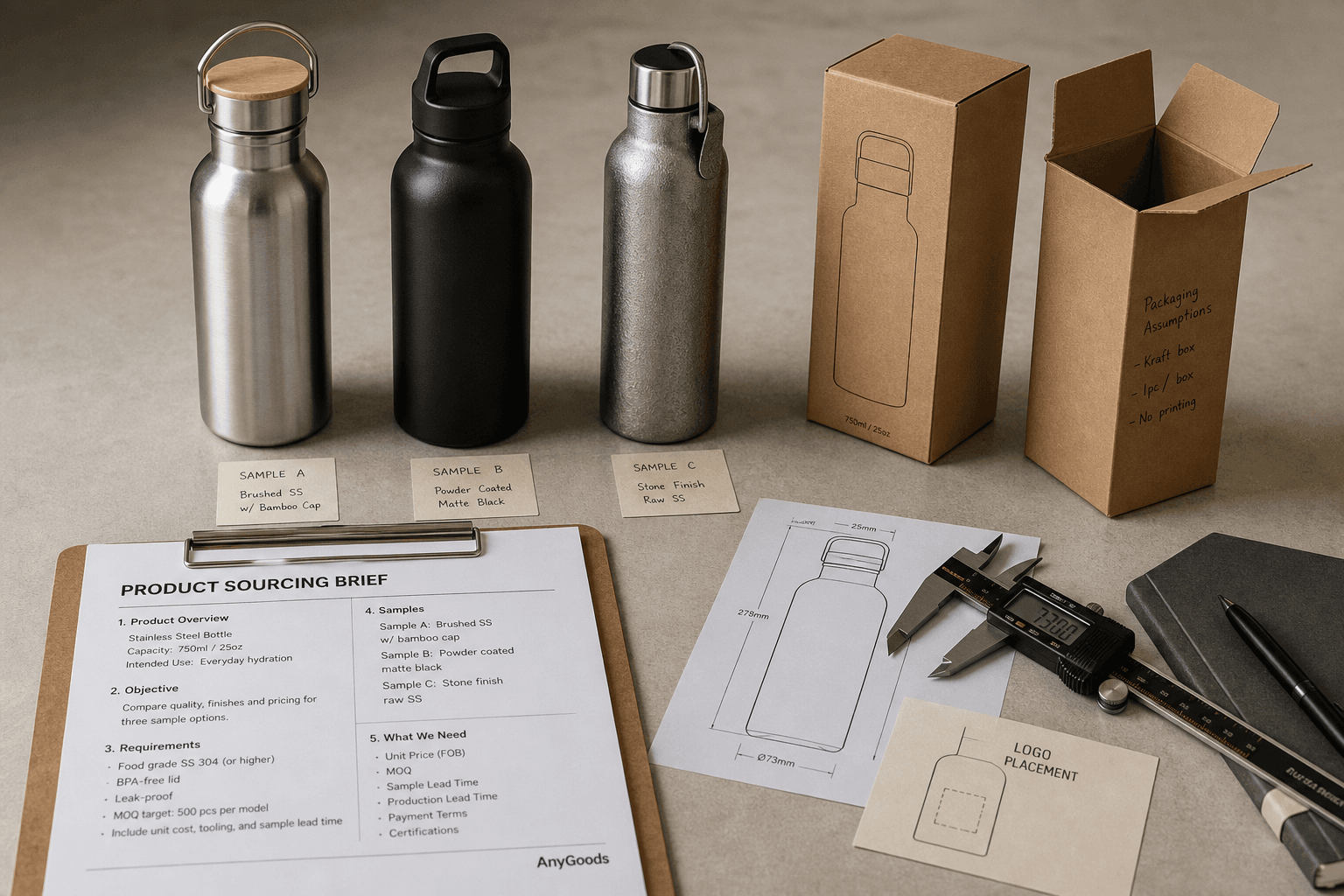
If your brief is still loose, fix that before you ask anyone else to quote. A proper product sourcing brief is what makes suppliers answer on the same basis instead of each quoting their own version of your product.
When the right answer is still no
For plenty of ecommerce brands, adding a second supplier is premature.
Low-volume products are the obvious case. If one supplier quotes sensibly at 5,000 units and both suppliers become awkward at 2,500, you may pay more, hold more stock, and still not have meaningful protection. The same is true when the product is not stable enough to compare properly. If your current supplier is still helping you sort out fit, finish, or packaging issues, qualifying another factory at the same time can make root-cause analysis miserable.
Regulated and documentation-heavy categories raise the bar even further. For food, the FDA says covered importers must develop, maintain, and follow a Foreign Supplier Verification Program for each food and each foreign supplier (FDA FSVP key requirements; FDA FSVP guidance). For children’s products, some categories require testing by a CPSC-accepted lab and certification, depending on the product and rule involved (CPSC testing and certification rules).
That does not mean every new supplier triggers the same compliance steps in every category. It means you should assume nothing just because the product photo looks the same.
Worked example: a home-goods SKU that may have earned a second source
Say you sell a powder-coated steel kitchen organizer. This is a hypothetical example, not market pricing.
The product has been unchanged for a year. Packaging is stable. Returns are low. The problem is timing: your current supplier keeps shipping late before peak season.
Here is the incumbent supplier on the latest reorder:
- Factory price: $4.20 per unit
- Packaging: included
- MOQ: 3,000 units per color
- Quoted lead time: 55 days
- Actual lead times on the last three shipments: 58, 63, and 69 days
A candidate supplier quotes this:
- Factory price: $4.38 per unit
- Packaging: included to the same carton spec
- MOQ: 2,000 units per color
- Quoted lead time: 50 days
- Tooling: none
If you stop at ex-factory price, the incumbent wins. That is exactly how people make bad sourcing decisions.
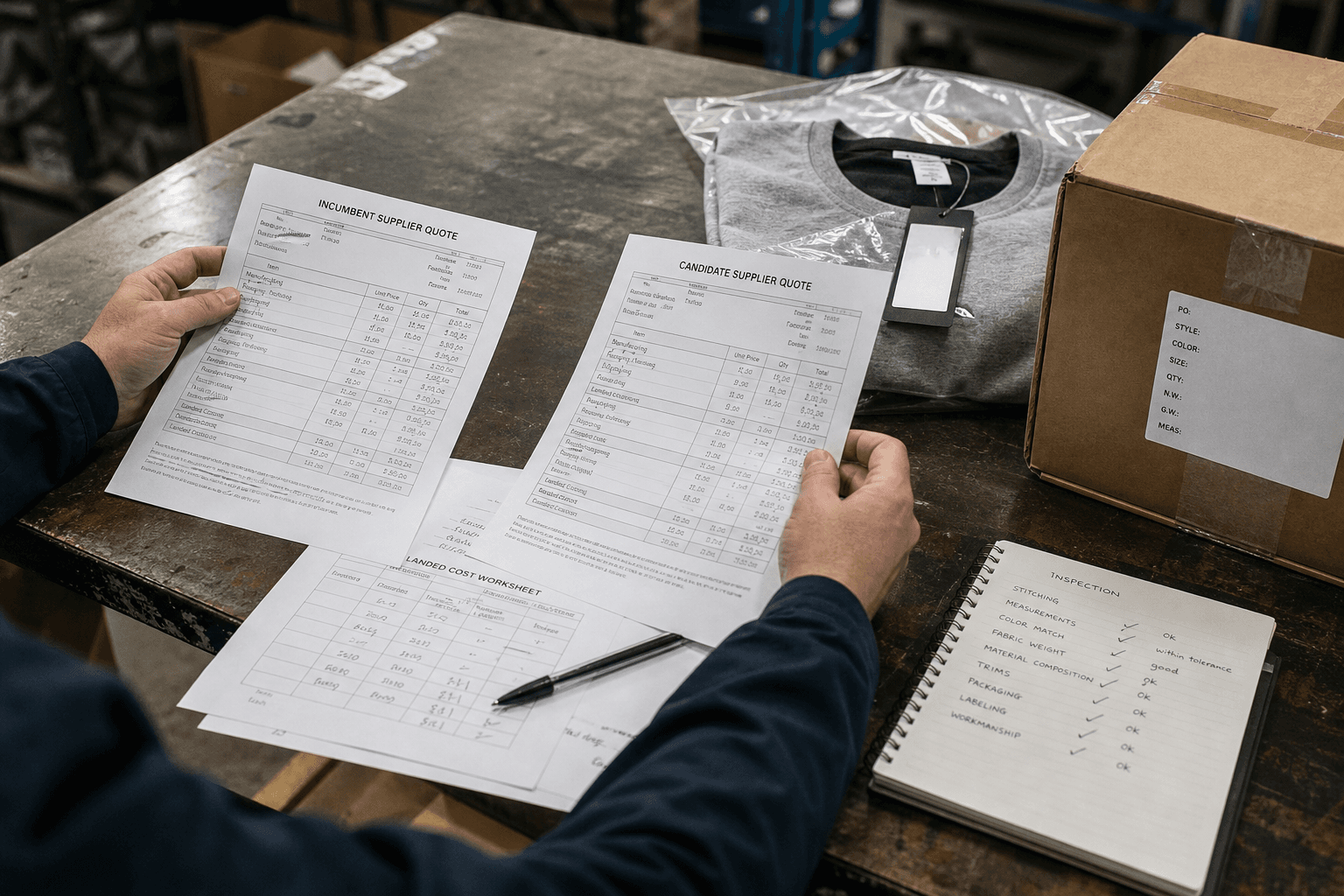
You need both quotes on the same cost boundary. If both need inspection, add inspection to both. If one supplier’s carton spec increases damage risk or freight volume, account for that. If one deposit structure ties up more cash, include that. This is the same discipline you would use in how to compare manufacturing quotes and a proper landed cost calculation for ecommerce.
Here is a simple hypothetical adjustment:
- Incumbent factory price: $4.20
- Candidate factory price: $4.38
- Candidate inspection allocation on a smaller trial order: +$0.07 per unit
- Incumbent historical delay penalty: assume $1,800 in air-freight rescue cost over the last 18,000 units, which is $1,800 / 18,000 = $0.10 per unit
That gives you an illustrative operating view:
- Incumbent adjusted cost: $4.20 + $0.10 = $4.30
- Candidate trial-order adjusted cost: $4.38 + $0.07 = $4.45
The candidate is still more expensive, but only by $0.15. Now you have a real decision instead of a fake cheap-versus-expensive one.
At this point, the next questions matter more than another round of haggling. Ask the candidate supplier:
- Which components are made in-house and which are subcontracted?
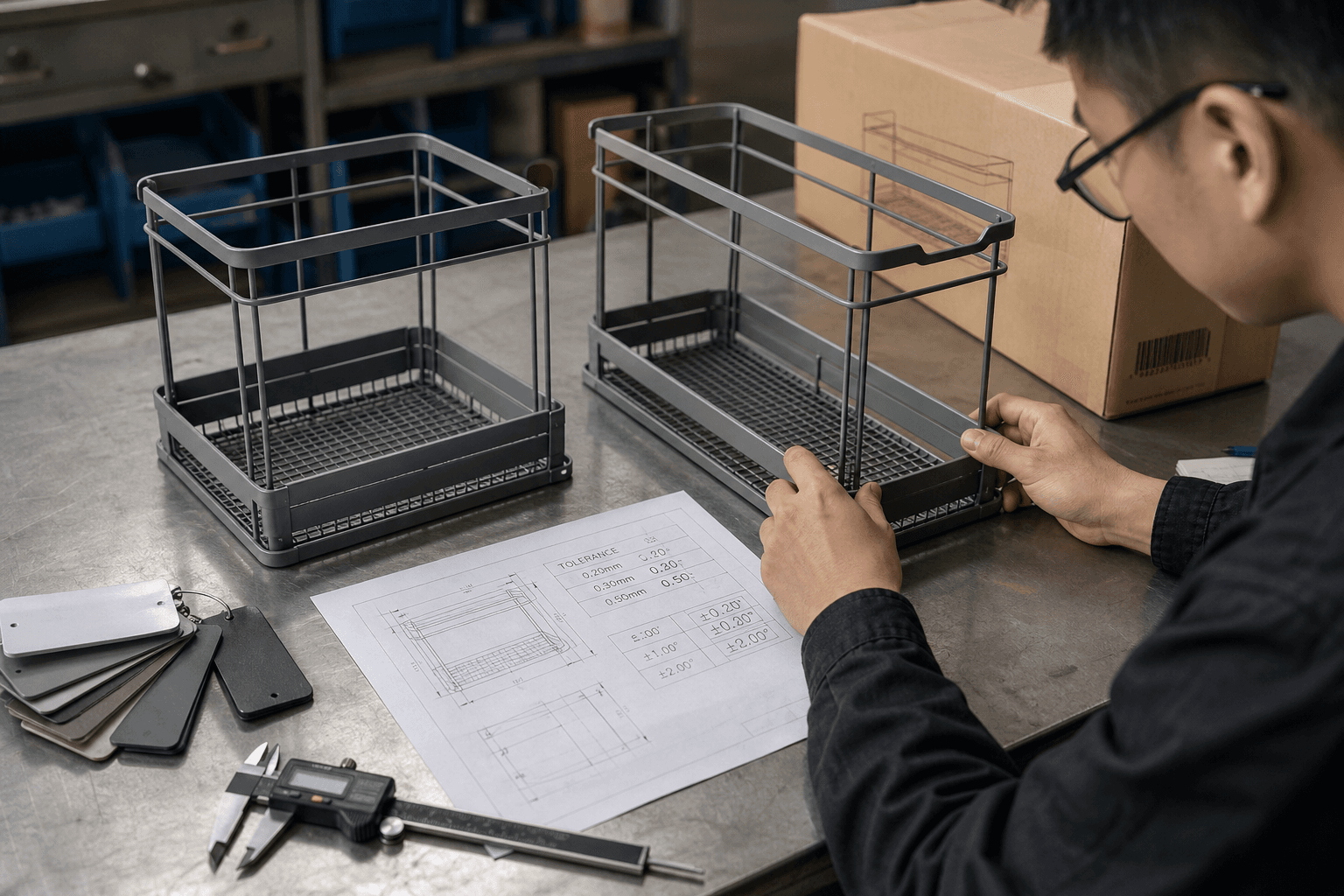
- What tolerances can you hold on wire diameter, weld finish, and flatness?
- What finish standard and reference sample will production follow?
- How do you check coating consistency and adhesion in production?
- Can cartons and master packs be lot-coded by production date?
Then test the sample against your actual failure points. In this example that might mean wobble on a flat surface, visible finish variation under retail lighting, poor weld cleanup, damaged corners after transit simulation, or barcode placement errors that create receiving issues.
If the sample passes, the spec is tight, and the stockout risk is painful, this SKU probably has earned a second supplier qualification. Not necessarily a 50/50 split. More often the better first move is a controlled trial order, heavier inspection on the first bulk run, and a later decision on whether to keep the second factory as backup capacity or give it a live share of future volume.
Follow the same SKU through the next decision: backup or split live volume?
Suppose the candidate passes sampling and the first production lot is acceptable. Should you split future orders across both factories?
Not automatically.
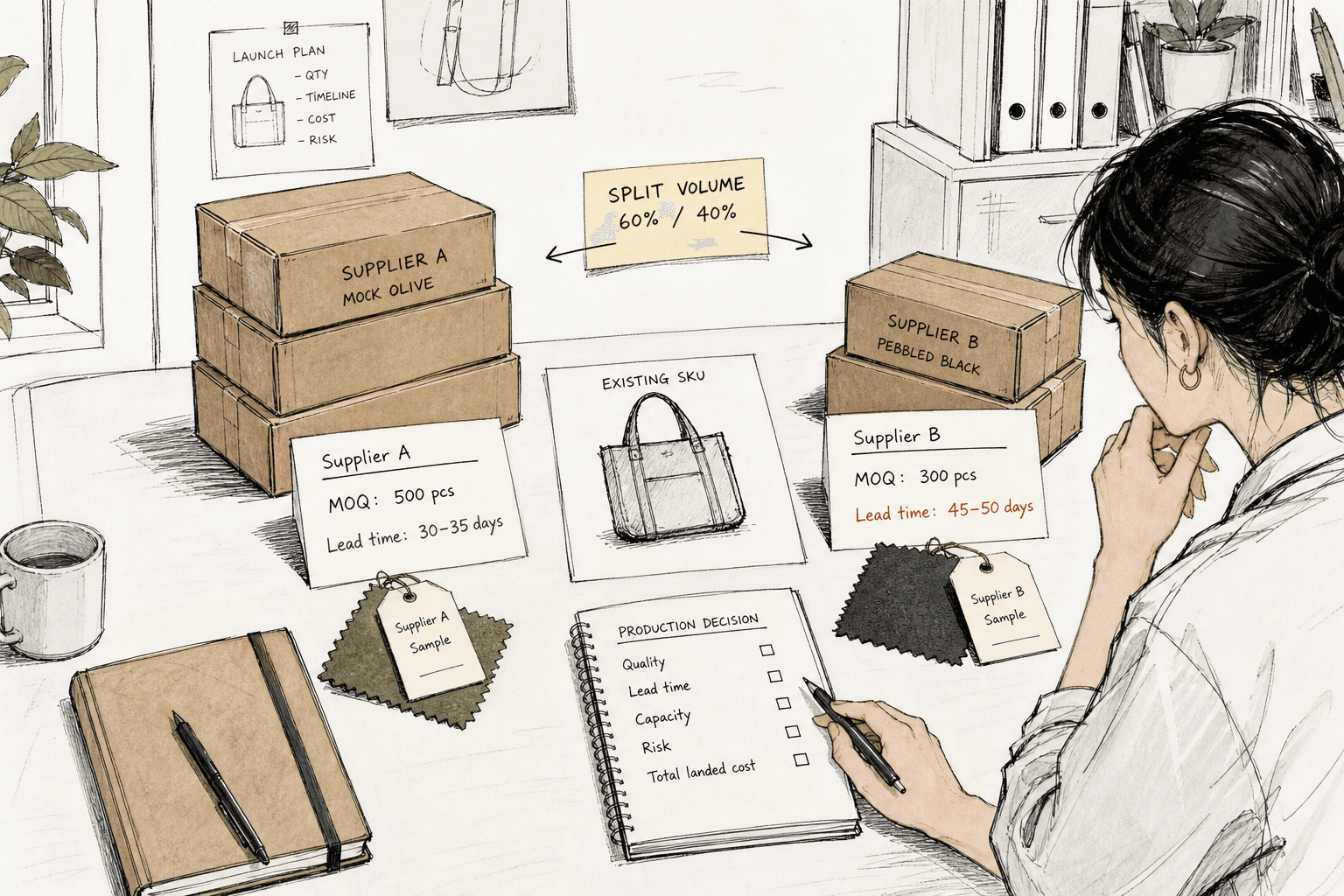
Use the same criteria again. If the incumbent still gives you the best pricing at concentrated volume and the second supplier mainly protects peak-season capacity, keep most volume with the incumbent and reserve the second supplier for overflow or contingency. If the second supplier shows comparable quality, cleaner lead times, and lower MOQ by color, a live split may make sense.
For the kitchen organizer, imagine your normal reorder is 6,000 units. A 3,000/3,000 split matches the incumbent’s MOQ but may give you less pricing leverage and two separate booking flows. A 4,000/2,000 split might preserve better economics while keeping the second source active. The right answer depends on the actual MOQ terms, freight efficiency, and how much inventory buffer you need to carry for each lane. There is no universal ratio worth memorizing.
What should you inspect in the first two live runs? Look for lot-to-lot color consistency, assembly fit, packaging durability, labeling accuracy, and whether actual lead times match the quote. Those findings change the next decision. If the second supplier’s lead time advantage disappears in production, it may remain a backup only. If quality and delivery hold, it may deserve more volume.
A different example: the same idea, heavier consequences
Now imagine the product is an imported snack or a children’s item instead of a kitchen organizer.
The commercial logic can still support a second supplier. The qualification burden is simply heavier.
For food, FSVP is supplier-specific, which means a new foreign supplier is not just another quote to compare. It is part of a separate importer verification obligation (FDA FSVP key requirements). For children’s products, whether third-party testing and a Children’s Product Certificate apply depends on the product and applicable rule, but supplier qualification can involve more than appearance and unit cost (CPSC testing and certification rules; CPSC toy safety guidance).
In those categories, the tradeoff changes. The hidden cost is not usually the quoted unit price. It is duplicated verification, records, testing paths, and slower internal decision-making. If the SKU is modest in volume, the sensible answer may be to stay single-sourced for now and work on forecasting, safety stock, or tighter supplier management instead.
One approved sample does not prove supplier equivalence
This is where second-supplier plans often get into trouble. Someone receives a decent sample, decides the product is “basically the same,” and treats qualification as done.
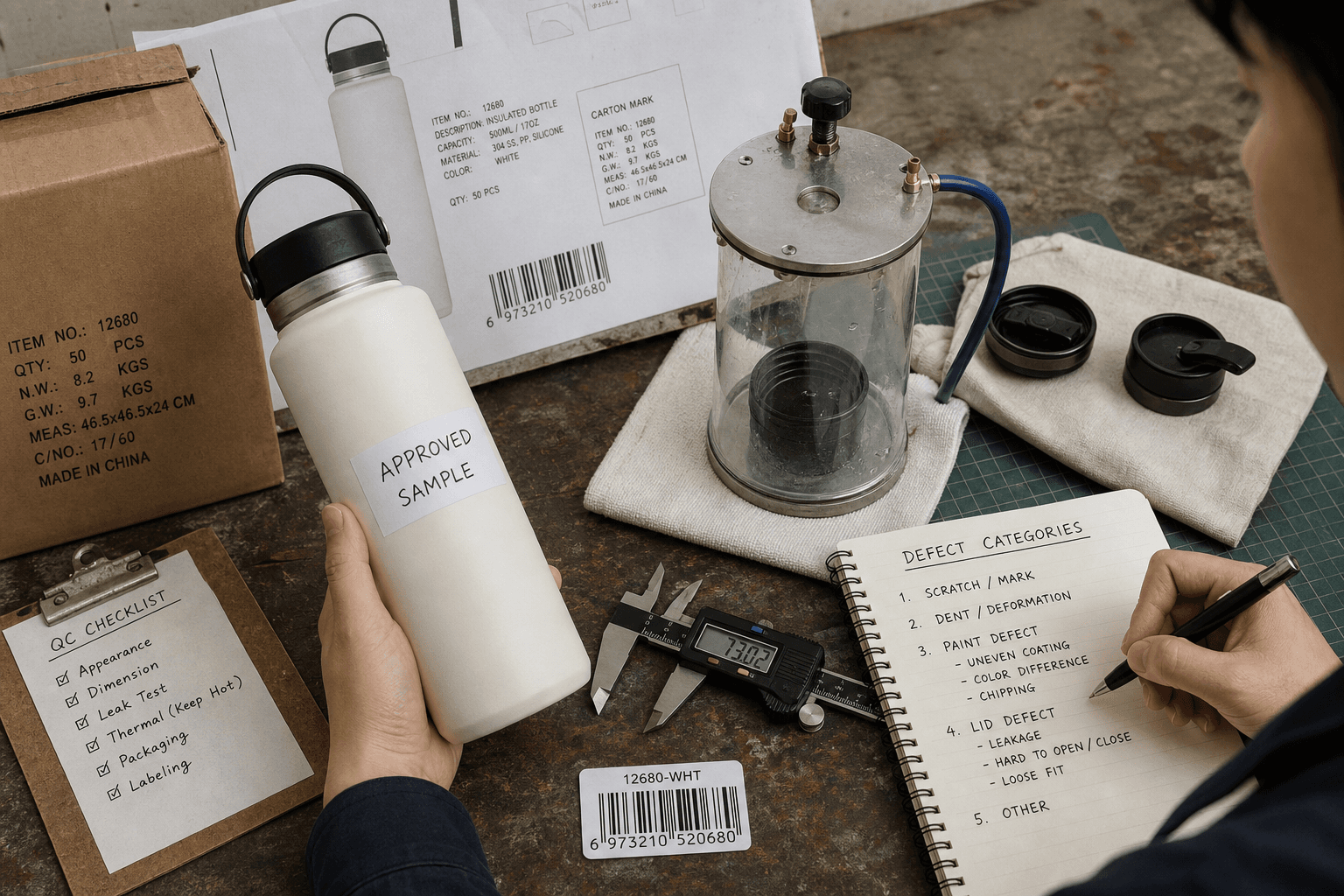
It is not done. Acceptance sampling is a tool for deciding whether a lot is acceptable, but it is not the same as proving that two factories are equivalent over time or estimating overall process quality (NIST acceptance sampling overview). A supplier can produce one good pre-production sample and still run unstable bulk output because of material variation, subcontracting, weak process control, or packaging shortcuts.
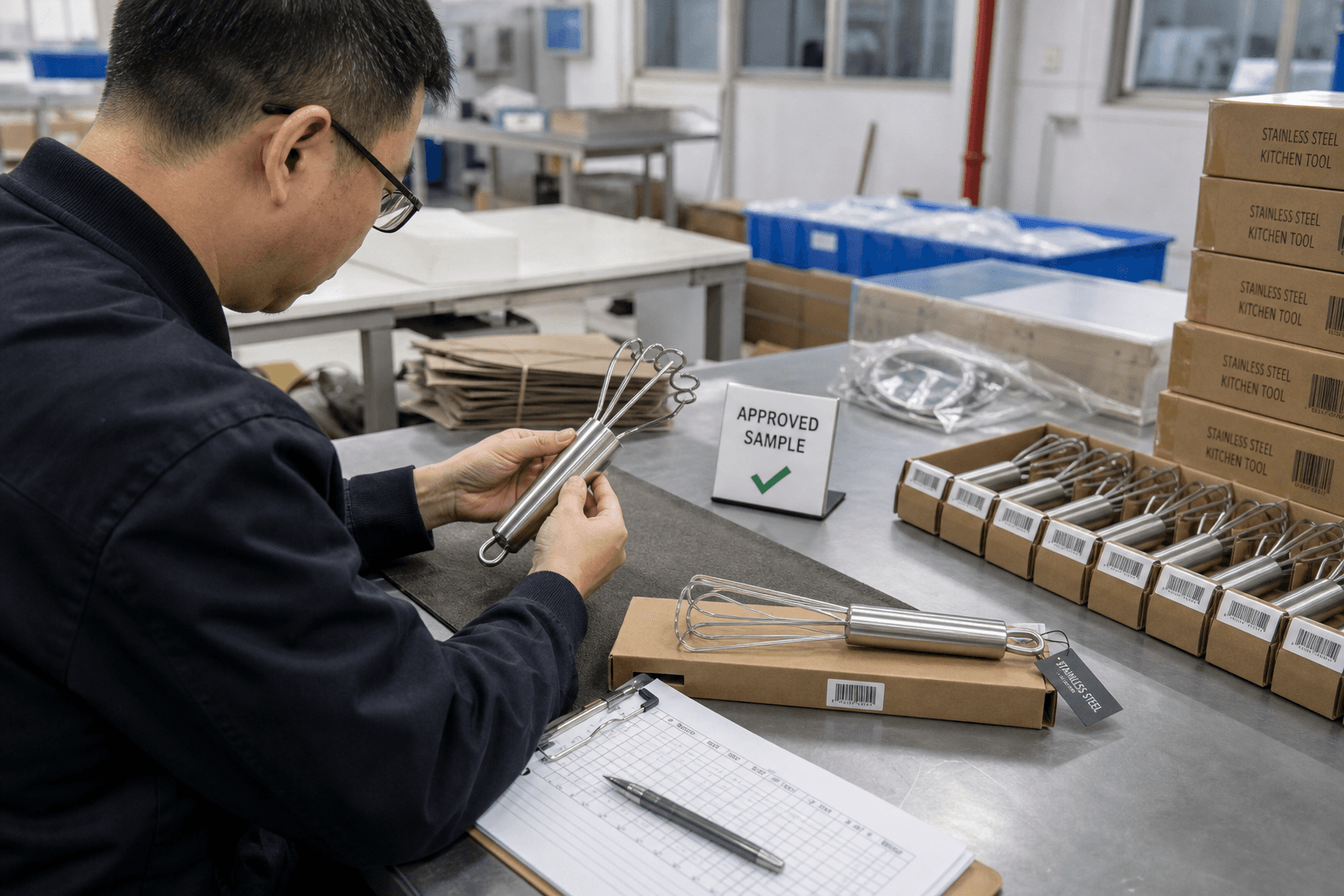
So inspect for what changes the next buying decision. Are multiple sample units consistent, not just one polished hero sample? Are critical dimensions measured in process or only at final inspection? Can production lots be traced to dates and component batches? Does packaging survive the handling your channels actually impose? If those answers are fuzzy, you do not have a qualified second source yet.
A supply change can quietly break your claims
A second supplier can also affect labeling and origin claims in ways teams miss until packaging is already printed.
If you make U.S.-origin claims, the FTC says an unqualified “Made in USA” claim requires that the product be “all or virtually all” made in the United States. A sourcing change may mean a qualified claim is more appropriate, or no such claim at all (FTC Made in USA guidance). Customs marking and origin treatment are separate questions, and CBP’s rulings materials make the larger point: product-specific facts and packaging details matter (CBP rulings program).
This is not just a legal footnote. It is a packaging, marketplace, and retailer-data problem if you discover it late.
What information you need before deciding this week
Before you approve a second-source sample or commission one, gather the inputs that actually move the decision.
Start with the product spec. It should define materials, dimensions, tolerances, finish, packaging, labels, inserts, and approved reference samples. Without that, quote comparison becomes fiction.
Then pull current supplier performance in plain numbers: quoted lead time versus actual, defect or rework history, MOQ flexibility, and what happened on the last few engineering or packaging changes.
Next, compare commercial terms on the same basis: factory price, setup or tooling charges, packaging, inspection, freight assumptions, tariff review, payment terms, and the inventory effect of split orders. If your gross margin looks fine but split orders tie up more working capital and force more buffer stock, that still matters. Contribution margin and cash exposure are not the same thing.
After that, review what the supply change does to compliance and claims: origin facts, labeling capability, product-safety testing, supplier verification records, and any retailer documentation requirements.
Finally, name the internal owner. Someone has to approve the retained sample, define incoming inspection points, and decide what result would justify moving from sample approval to a live production trial.
The next supplier conversation should resolve four things
If you are serious about a second source, the next conversation should answer four questions.
First, what exactly will this supplier make, and what will be subcontracted?
Second, how will they control your critical spec points in bulk production, not just in a sample room?
Third, what MOQ, lead time, and capacity terms apply at the order size you can really place?
Fourth, what documents and origin facts do you need from them for customs, labeling, testing, or supplier-verification records?
If your team needs help running that qualification work without giving up the factory relationship, AnyGoods lays out its sourcing support at /#services and the workflow at /#process. That is most relevant when the product is already proven and the hard part is comparing the next supplier on the same spec, cost boundary, and risk standard.
The decision this week is simple enough. If the SKU is stable, the cost of disruption is material, and you can qualify the second source properly, move to a sample and a normalized quote comparison. If not, keep one supplier for now and fix the spec, forecast, or inventory plan before you create two versions of the same headache.
Production and reorder planner
Connect the order milestones to the launch or reorder decision.
Build a range for uncertain dates and demand. Confirm supplier commitments and logistics requirements before relying on a timeline.
See a completed example
- Order and demand scenario
- Record SKU, order quantity, stock on hand and realistic low/base/high demand assumptions. Note where demand data came from.
- Before production
- List specification freeze, sample approval, materials, tooling and deposit milestones, with owners and dependencies.
- During production
- Record production start, check-in dates, inspection points, change approval and the latest date for escalation.
- Before shipment
- Confirm inspection release, balance payment, packing data, carton labels, bookings and destination receiving requirements.
- Delivery and receiving
- Plan transit, customs clearance, fulfillment appointments and inventory availability. Keep estimates distinct from confirmed dates.
- Reorder decision
- Estimate demand during replenishment lead time and add a justified uncertainty allowance. Document the evidence that will trigger the next order.
- Contingency
- Name the specific delay or shortage risk and its response. Compare split shipments, alternate materials or a second supplier on cost and fit.
Make your own brief
Your entries stay in this tab. Download before leaving; they are not saved or sent to AnyGoods.
Sources & further reading
- CBP importing guidancecbp.gov
- CBP rulings programcbp.gov
- USITC Harmonized Tariff Informationusitc.gov
- NIST acceptance sampling overviewitl.nist.gov
- CPSC testing and certification rulescpsc.gov
- CPSC toy safety guidancecpsc.gov
- FDA FSVP key requirementsfda.gov
- FDA FSVP guidancefda.gov
- FTC Made in USA guidanceftc.gov
Published by AnyGoods Editorial. Examples are illustrative unless a source is identified. Updated .